Stop treating your split system installs like a side hustle (the regulators don't)
Installing split systems without UEE20120? Regulators do not see a favour; they see unlicensed trade work. Here is what that compliance gap means for you.
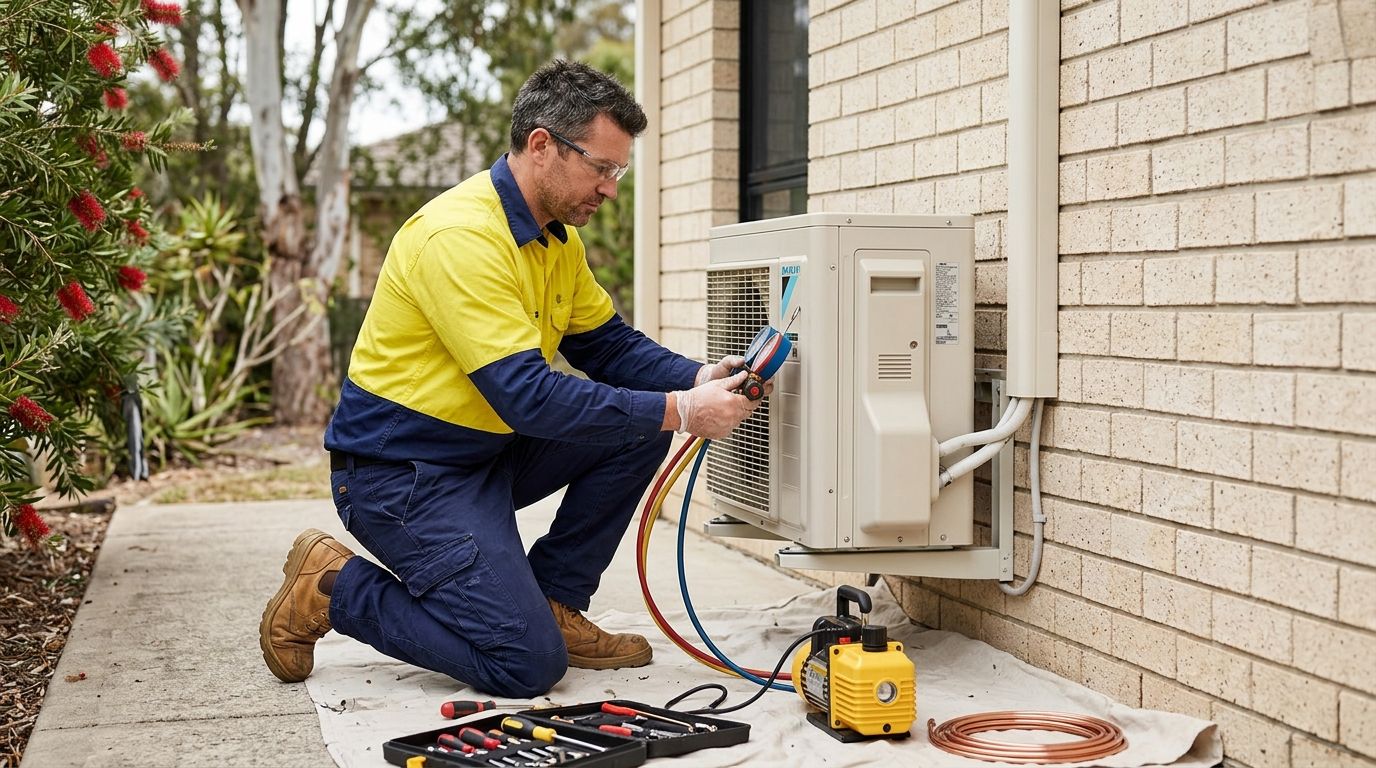
You think you're doing a favour. The regulator thinks otherwise.
You know how to install a split system. You have probably done it dozens of times, if not hundreds. The job takes a couple of hours, the customer is happy, and the extra cash is handy. To you, it is a favour and a natural extension of your daily trade work.
The problem is that the regulator does not see it as a favour. They see a clear pattern of unlicensed trade work in a highly regulated sector.
This is not about exaggerating the situation; it is the legal reality of performing air conditioning and refrigeration work for payment without holding the required qualification. In Australia, split system installation—including connecting the refrigerant lines and doing the associated electrical work—is classified as regulated work under state and territory laws. There is no grey area or room for loose interpretation here. If you accept payment for this work without holding the right credential, you are operating outside the law.
The qualification that changes this position is UEE20120, the Certificate II in Split Air Conditioning and Heat Pump Systems. This is the nationally recognised credential that proves you have the skills to perform this work. Without it, your installations are unlicensed, regardless of your standard of workmanship.
That is a direct statement, but it is the legal truth. As an experienced trade professional, you need to know where you stand.
What 'just installing a split system' looks like on paper
Installing a split system involves two regulated areas of work: electrical connection and refrigerant handling. Both require specific licensing under state and territory laws. While the exact legislation varies between Queensland, New South Wales, Victoria, and the other states, the core legal principle is consistent across the country.
When you connect the indoor and outdoor units, run the refrigerant lines, and commission the system, you are performing regulated trade work. Learning the process on the job, having years of practical experience, or doing a favour for a regular customer does not change this legal classification.
The UEE20120 qualification exists to solve this problem. It is the nationally recognised credential that proves you have the skills and competency to perform this work to the required safety standards. It meets the specific qualification requirements that state and territory regulators expect to see on site. Without it, your installations—no matter how clean your pipework or how well the system runs—exist in a compliance gap that carries real regulatory risk.
It is also worth noting that split system installations often involve regulatory requirements beyond UEE20120 alone. The Australian Refrigeration Council (ARC) manages the licensing for refrigerant handling, and depending on the exact scope of your work, an ARC licence may also be required. The precise relationship between UEE20120 and ARC licensing requirements depends on your state and the specific nature of the work you perform. If you are unsure about what rules apply to your current situation, checking directly with your state's electrical licensing authority or the ARC is the safest move, rather than assuming your existing trade licence covers the work.
The three trades most likely to be in this position
Three specific trade groups account for most uncertified split system installations in Australia. If you are reading this guide, you likely work in one of these sectors.
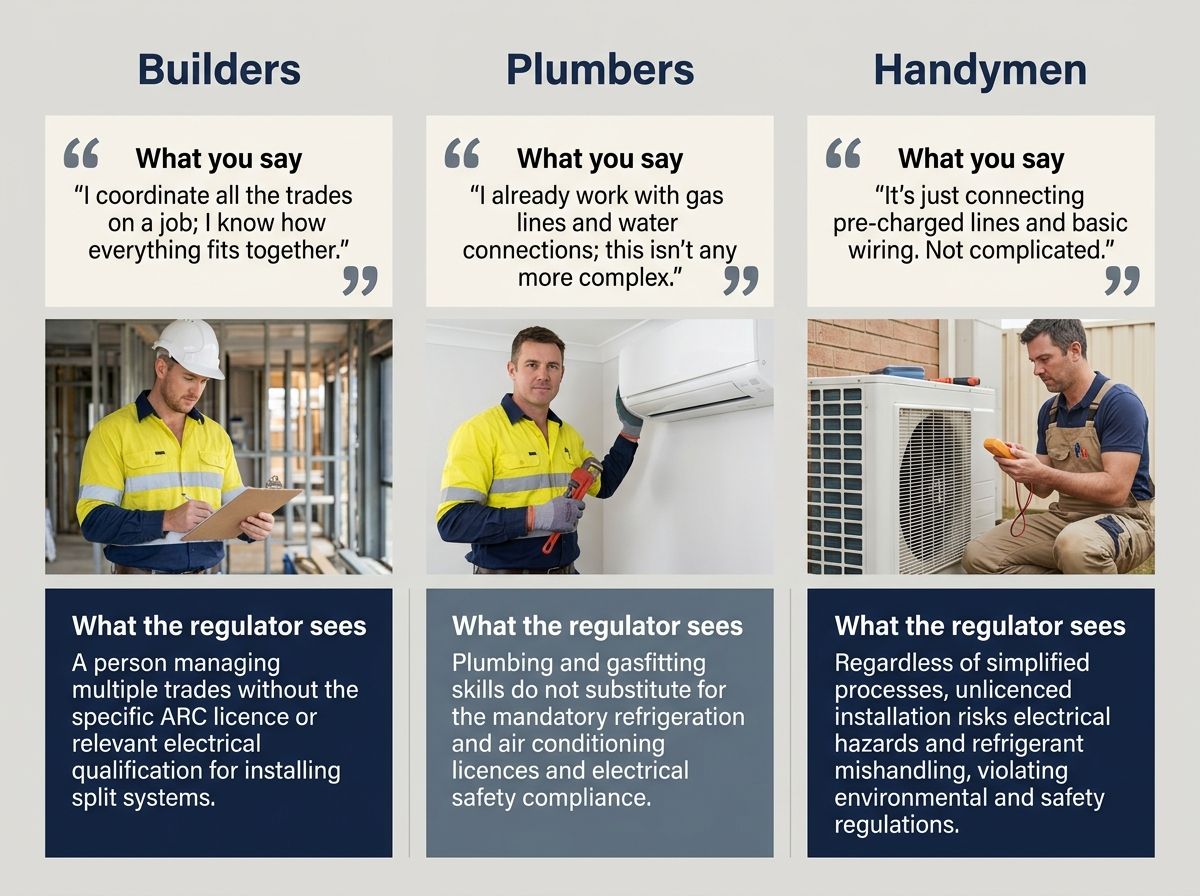
Builders
'I only mount and connect the units. The electrician handles the main power connection.'
The problem is that connecting the indoor and outdoor units, running the refrigerant lines, and commissioning the system constitutes regulated work. The main electrical connection at the board is only one part of the job; handling the refrigerant lines is another. Both tasks require the appropriate qualifications, meaning that mounting and connecting the unit is the core of the regulated work.
Plumbers
'I hold a full plumbing licence, so running pipework is second nature to me.'
The problem is that a plumbing licence covers plumbing work. Installing a split system requires refrigerant handling and specific electrical work, neither of which falls under a standard plumbing licence. While your pipework and flashing skills are highly relevant, they do not replace the specific electrical and refrigeration qualifications mandated for this work.
General handymen and multi-trade contractors
'It is a straightforward job. The customer just wants the unit on the wall and running.'
The problem is that licensing regulations do not change based on how simple the installation seems. A quick domestic install is still regulated trade work. A customer's request or tight schedule does not create a legal exemption from licensing laws.
There is also a common misunderstanding that is worth addressing directly: holding a general electrical licence, such as UEE30820 (Certificate III in Electrotechnology Electrician), does not automatically authorise you to perform all split system installation work. The specific scope of what a general electrical licence covers regarding refrigerant handling varies significantly from state to state. If you hold an electrical licence and have been assuming it covers all your split system installations, you should verify this with your state's licensing authority before taking on your next job.
What the regulator sees when looking at your work history
This is the most critical shift in perspective.
You see individual projects: an add-on during a renovation, a quick job for a repeat client, or helping out a mate. Each task feels like an isolated job.
An investigator sees a pattern of performing regulated trade work for money without the correct qualification. That ongoing pattern of work is what triggers formal enforcement action. They look at your overall trade activity, not just a single installation.
What triggers a regulatory investigation? It varies. It could be a simple complaint from a customer whose system has failed, or an insurance claim that prompts a detailed review of the installation. A routine site audit can easily bring unlicensed work to light, as can a report from a competitor or colleague. Regulatory investigations into unlicensed trade work are not rare events saved only for the most extreme cases. They happen when something goes wrong and assessors start asking who did the work and whether they held the proper qualifications to do it.
The downstream consequences of unlicensed work extend far beyond the installer. When a split system is installed by someone without the required qualification, serious questions arise regarding the validity of the manufacturer's warranty, the position of the owner's building insurance, and who carries the liability if something goes wrong. These are not hypothetical risks. They are the practical, everyday consequences of a compliance gap, and they affect your customers just as much as they affect your business.
This is not about causing alarm. It is about laying out the practical realities of your trade environment. You have the skills and your installations are functional, but the gap lies in the formal recognition of those skills, not your actual ability.
UEE20120 is the line between risk and recognition
The UEE20120 Certificate II in Split Air Conditioning and Heat Pump Systems is a national qualification under the Australian Qualifications Framework. It provides formal recognition of your competency to install, commission, and service these systems safely.
This qualification is not about teaching you how to install a unit. If you have done this work for years, you already have the practical skills. UEE20120 translates those existing skills into a verified format that regulators, insurance companies, and main contractors accept.
That is the clear division. On one side, you have years of practical work known only to you and your clients. On the other, you have a formal credential that makes your skills visible and valid within the regulatory framework.
Obtaining this qualification is more than jumping through a bureaucratic hoop; it is the process that makes your trade skills legally compliant. Without it, you operate with unnecessary business risk. With it, you are fully authorised to perform the installations you have been doing for years.
For experienced trade professionals, getting your UEE20120 does not require going back to a classroom. Recognition of Prior Learning (RPL) is a formal assessment pathway that evaluates your existing experience against the national qualification requirements. If your practical experience demonstrates the required competency, the qualification recognises it. While the assessment process is thorough and is not a simple rubber-stamping exercise, it is designed to evaluate what you already know rather than trying to teach you skills you already use every day.
Your experience is real, but is it recognised?
You already have the hands-on experience. Your history is full of completed installations, commissioned systems, and satisfied customers. That background is valuable and forms the foundation of your professional standing.
The issue is not your capability on site. The issue is whether the licensing system formally recognises that capability.
Recognition of Prior Learning (RPL) is the formal mechanism that bridges this licensing gap. It is an assessment process under the Australian Qualifications Framework where your practical experience is evaluated against the competency requirements of a qualification. You do not need to study or sit in a classroom. Instead, you document the work you already perform, and a qualified assessor from a registered training organisation evaluates whether that evidence proves you meet the national standards.
This evidence typically includes records of previous installations, references from employers or clients, photographic documentation of your work, and your own description of the tasks you perform on site. The exact requirements depend on the registered training organisation and the qualification being assessed. If your experience does not cover every competency requirement, targeted gap training can be completed as part of the process so you can fill those specific areas.
This pathway is not a shortcut or a quick fix. It is the standard compliance route for experienced trade professionals who need their hands-on skills converted into a formal qualification. The assessment is thorough, the resulting qualification is fully recognised, and your status remains permanent once issued.
Your practical skills are solid, but they need to be formally documented to protect your business.
Find out where you stand
Before making any commitments, you can check if your practical background is suitable for a UEE20120 RPL assessment. That is the purpose of the Free Skills Review.
This review is free and carries no obligation. It is a straightforward, practical assessment of your experience rather than a sales pitch. If you are a good candidate for RPL, we will let you know. If a different route is better, we will tell you that too.
You already do the work on site. Getting your skills formally recognised is the next step. Find out what is required.
Ready to Get Recognised?
Start with a free skills review to find out if RPL is right for you.