Training Your New Boss: The Reality of Working Without Formal Recognition
You have the experience. They have the certificate. If you have ever trained someone who now outranks you, this is for you — and there is a pathway forward.

You Know More Than They Do — And You Both Know It
You have been here longer. You know the system. You know the clients, the quirks of the workflow, the shortcuts that actually work and the ones that cause problems three weeks later. And then someone new arrives — qualified, enthusiastic, and formally credentialled in a way you are not. Within a fortnight, you are the one walking them through the job. Within a month, they are your supervisor.
This is not a rare situation. Across construction, healthcare, business, IT, and hospitality, experienced workers regularly find themselves carrying the practical knowledge while someone else holds the formal title. The quiet indignity of it is real. So is the professional frustration. And neither of those things reflects a failure on your part.
You have the experience. The paper just says otherwise.
This Is Not About Skill. It Is About a System.
The Australian employment and vocational education system recognises competence through formal credentials. Not through demonstrated performance. Not through years of reliable, skilled work. Through a document issued by a registered training organisation, assessed against a national standard.
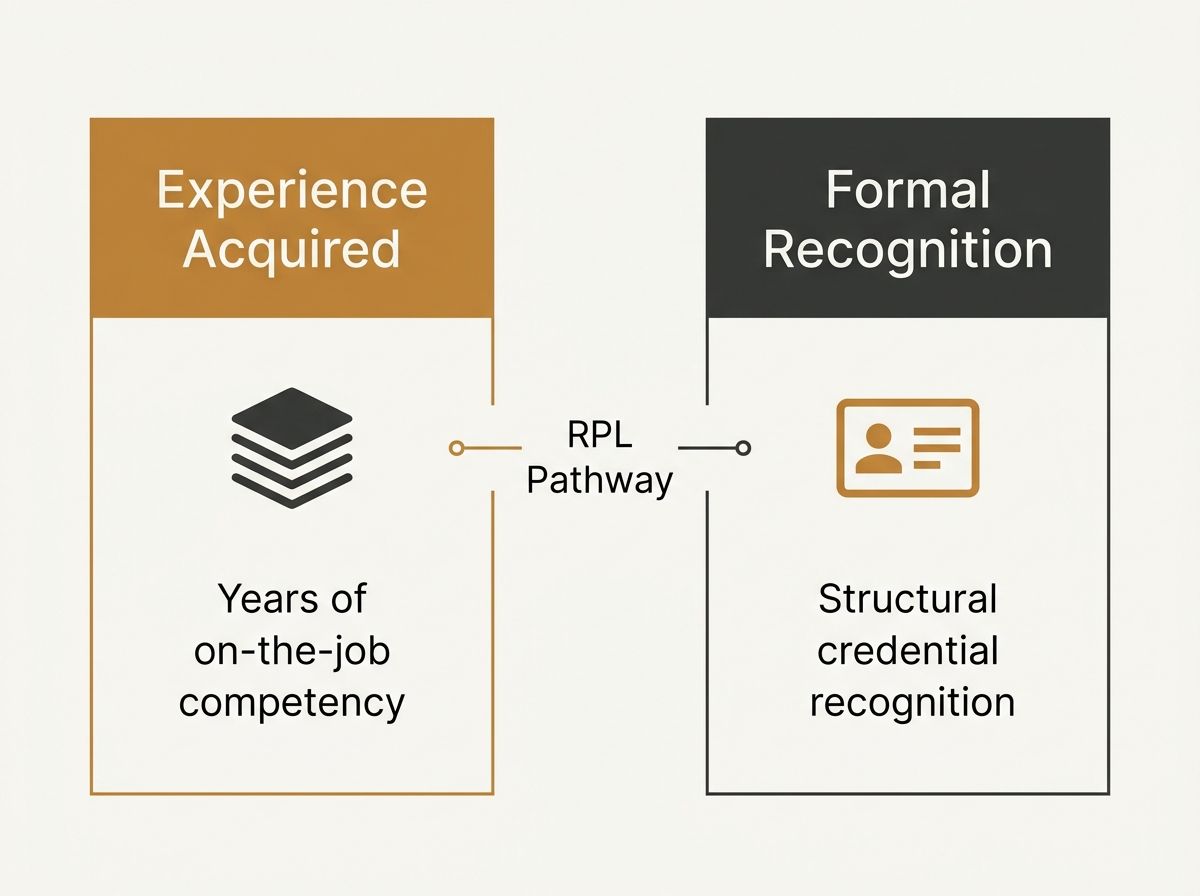
This is a design feature, not a flaw in you. The person who outranks you is not necessarily less capable — they simply hold the document the system requires. And the system, by design, uses that document as a proxy for competence.
Experience is not less than education. It is a different form of evidence.
Australian research has noted that many organisations narrow their recruitment pool by requiring specific credentials rather than assessing demonstrated competency — screening by qualification format rather than by what a candidate can actually do.
The Australian Human Rights Commission's inclusive recruitment guidance notes that many organisations narrow their potential recruitment pool by requiring a sequence of specific skills and experiences — which may include formal qualifications as screening criteria — rather than considering transferable skills and demonstrated competencies.
The result is a structural gap between how competence is acquired — through years of real work — and how it is formally recognised. That gap is not personal. But it is yours to close.
The Specific Moments It Becomes Impossible to Ignore
The credential gap is not always visible. Then, suddenly, it is — and it tends to show up in the same recurring moments, across industries, across roles.
- The promotion that went to someone with less time in the role but the right certificate. You were the obvious choice. The system disagreed.
- The pay negotiation where your experience was acknowledged — warmly, even — but the qualification ceiling held firm. 'We'd love to pay you more, but the band requires the credential.'
- The tender or contract that required a formally credentialled person to sign off. You could do the work. You couldn't put your name on the document.
- The performance review where 'extensive experience' was noted as a strength, and 'formal qualification' was noted as a development area — as if the two were equivalent gaps.
- The job advertisement for a role you have been doing informally for two years, requiring a qualification you don't hold.
These are not isolated incidents. They are the same structural gap, repeating.
The data reflects this pattern. According to the Australian Bureau of Statistics, men with a Certificate III or IV as their highest non-school qualification were employed full-time at a rate of 69.6%, compared to 42.8% for those without any non-school qualification. For women, the figures were 39.1% and 23.0% respectively.
The ABS Education and Work survey shows that holding a Certificate III or IV is associated with substantially higher full-time employment rates compared to having no formal qualification — a gap that reflects how the labour market values formal credentials.
The employment rate for people with a Certificate III or IV as their most recent qualification was 77.6%, compared to 57.0% for those without any non-school qualification.
If this pattern feels familiar — the experience that formal systems refuse to see — you are not alone in it.
What the RPL Certificate Process Actually Does
Recognition of Prior Learning — RPL — is a formal assessment pathway that evaluates the competency a person has acquired through formal, non-formal, and informal learning, to determine the extent to which they meet the requirements specified in a training product.
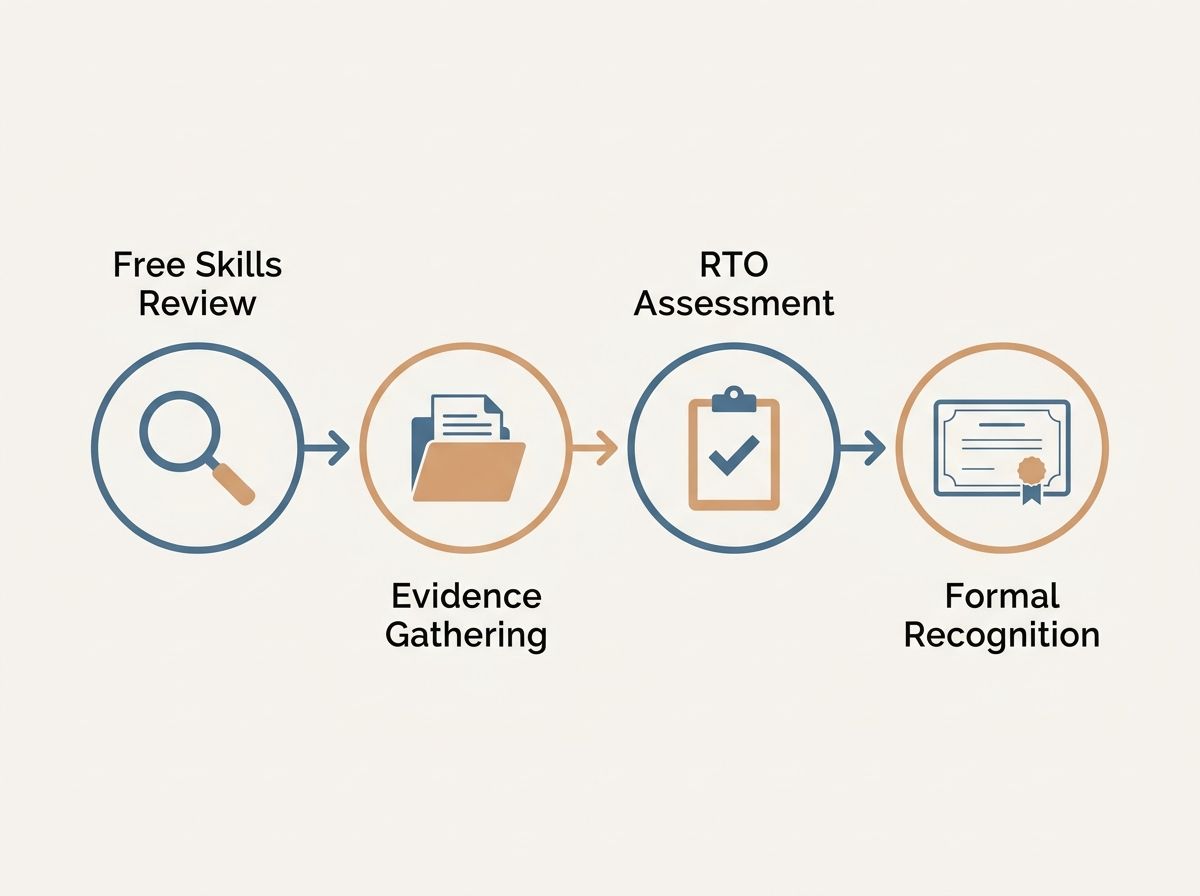
According to ASQA's 2025 Standards FAQs, RPL assesses the competency of an individual that may have been acquired through formal, non-formal and informal learning — including on-the-job experience — to determine the extent to which that individual meets the requirements specified in a training product.
In plain terms: RPL is not a training program. It is an assessment of what you already know and can demonstrate. The qualification is issued by a registered training organisation (RTO) — the RTO conducts the assessment, and the RTO issues the credential. RPL it guides candidates through the evidence-gathering and documentation process, helping present existing competency in the format the assessment requires.
Experience can be evidence. The RPL process is the mechanism that makes it so.
Where gaps in knowledge or skills are identified during assessment, the candidate will be required to undertake gap training and assessment to meet the requirements of the qualification.
It is also worth knowing that an RTO can recognise relevant skills and competencies obtained from another training package as part of the RPL evidence — meaning prior formal qualifications, statements of attainment, or training from other contexts can contribute to the evidence base.
This is a rigorous process. It is genuine assessment. The qualification that results from it is nationally recognised precisely because the assessment is real — not because it was bypassed.
Who the RPL Certificate Pathway Is Actually For
The RPL pathway is designed for people who already have the competency — and can demonstrate it. Honest guidance about suitability matters here, because the pathway is not for everyone, and saying so is the foundation of trust.
A strong candidate for the RPL certificate pathway in Australia typically has:
- Substantial, relevant, and reasonably recent work experience in the field they are seeking recognition in
- The ability to document that experience — through employer references, work records, project examples, or other evidence
- A willingness to engage with a structured assessment process, which involves genuine evaluation of competency
- An understanding that the outcome depends on the assessment, not on enrolment
The pathway may not suit someone with very limited experience in the relevant field, someone whose background is in a significantly different area, or someone expecting a guaranteed outcome without genuine assessment. We would rather guide someone to the right pathway than enrol them in the wrong one.
The Free Skills Review exists precisely for this moment — to find out, without committing to anything, whether your experience maps to a qualification pathway.
Recognition Shouldn't Require Starting Over
You have been doing the work. You have been carrying the knowledge. You have been the one others come to when something goes wrong, when a decision needs to be made, when experience matters more than theory.
The RPL certificate pathway exists to align your formal credentials with the authority you already exercise. It is not a shortcut. It is not a workaround. It is a structured, legitimate assessment process that recognises what you have already achieved — in the format the system requires.
Your work deserves to be counted. Recognition shouldn't require starting over.
If you are ready to explore what an RPL qualification pathway might look like for your situation, the RPL qualifications available through RPL it span a wide range of industries and credential levels.
Explore the RPL qualifications available through RPL it — across construction, business, healthcare, IT, hospitality, and more.
The decision is yours. We will help you demonstrate what you already know.
Ready to Get Recognised?
Start with a free skills review to find out if RPL is right for you.