Stop Defending Your Overseas Degree — Do This Instead
Your overseas degree isn't the problem — defending it is. Learn why the Australian RPL system assesses your skills, not your certificate, and what to do instead.

The argument you keep having — and losing
You have the experience. Ten years of it, maybe more. Back home, you were respected — a professional with a track record, a qualification, a reputation. Here, you find yourself in a different kind of conversation. You are explaining your degree. Justifying your institution. Translating your credentials into terms an Australian employer or licensing body might accept.
This argument is exhausting. And it is structurally unwinnable — not because your qualifications are inferior, but because the Australian system was never designed to evaluate them the way you are presenting them. Research suggests that an estimated 70–80% of skilled migrants in Australia are affected by non-recognition of their overseas qualifications, with over 60% of those individuals potentially facing downward occupational mobility as a result.
This is not an individual failure. It is a structural pattern that repeats across thousands of skilled migrants every year — in healthcare, engineering, IT, trades, and business. The problem is not your competence. The problem is the frame.
The more energy you spend defending the paper you brought, the further you are from the pathway that actually works.
Why the Australian system doesn't care about your certificate
The Australian Qualifications Framework (AQF) and the vocational education and training (VET) system are built around competency standards — specific, measurable units of skill. When an assessor looks at your application, they are not asking: 'Is this degree equivalent to an Australian one?' They are asking: 'Can this person demonstrate competency against the relevant units?'
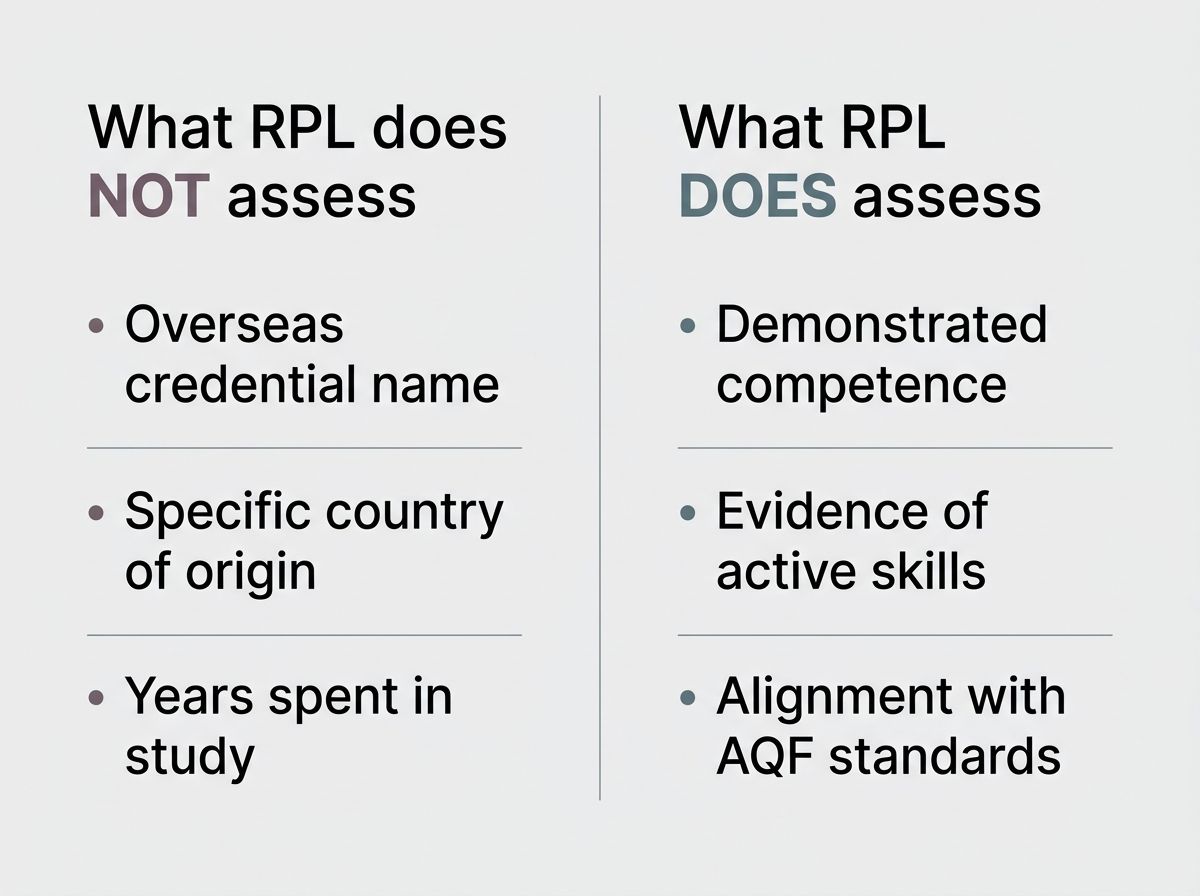
That is a fundamentally different question. And it changes everything about how you should approach recognition.
The system does not compare your degree — it assesses your competence. An overseas qualification is not irrelevant in this process, but it is not the primary currency either. What matters is whether you can show that you have the skills, knowledge, and experience that the qualification standard requires.
This is not a bias against overseas education. It is the architecture of the system. Understanding this distinction is the first step toward using it to your advantage.
The shift: from unrecognised degree to assessable experience
Experience can be evidence.
That is the reframe. Not a consolation — a mechanism. Recognition of Prior Learning (RPL) is the formal process by which your existing skills and experience are assessed against Australian qualification standards. It does not ask where you learned. It asks whether you can demonstrate what you know.
RPL is conducted by Registered Training Organisations (RTOs) — the same bodies that deliver and issue all nationally recognised VET qualifications in Australia. When an RTO assesses your competence through RPL and determines you meet the standard, they issue a qualification. That qualification is nationally recognised under the AQF.
Qualifications earned through RPL carry the same standing as those gained through traditional study. The assessment is genuine — it is not a shortcut or a workaround. It is the recognised pathway for people who have already done the work and can demonstrate it.
This is the shift: stop arguing about the paper you brought. Start presenting the evidence of what you know.
What gathering your portfolio actually means
The practical pivot looks like this: instead of arguing about your degree, you gather evidence of what you have done. Your employment history. Your references. Your work samples.

RPL assessments in Australia typically draw on a range of evidence types. These can include employment records and position descriptions, references or statements from supervisors and colleagues, examples of work you have produced, records of projects or tasks completed, and prior qualifications — including overseas ones.
Your overseas qualification is not irrelevant here. It can form part of your evidence portfolio. What it cannot do is substitute for demonstrated competency. The distinction matters: your degree shows you studied. Your evidence shows you can do.
The Western Australian Overseas Qualifications Unit notes that if an overseas qualification does not meet criteria for formal assessment, the holder may still be eligible for RPL — meaning the two pathways are complementary, not mutually exclusive.
The documentation process can feel daunting. That is normal. Structured guidance through the evidence-gathering stage is part of what an RPL support service provides — reducing the mental load so you can focus on presenting what you already have.
Is RPL right for your situation? An honest answer
RPL is rigorous. It is not a shortcut. And it is not right for everyone.
RPL through the VET system works well for people with substantial relevant experience who can gather evidence of their competence, and where the qualification they need sits within the AQF's vocational framework. It is the recognised pathway for tradespeople, business professionals, community services workers, hospitality workers, and many others.
However, there are professions in Australia where VET-level RPL alone does not satisfy registration requirements. A parliamentary inquiry into skills recognition identified three categories of professions: those regulated by law, those that are self-regulating, and those that are unregulated. For professions regulated by law — which include health-related professions, veterinary science, and architecture — eligibility to practise is determined through prescribed examinations and registration processes, not solely through VET qualifications.
The Australian Health Practitioner Regulation Agency (AHPRA) regulates 16 health professions, including nursing, medicine, pharmacy, physiotherapy, and psychology. International practitioners must undergo qualification assessment by the relevant National Board before registration. A VET-level RPL qualification alone does not grant registration in these professions.
If your target profession falls into a regulated category, RPL may still be part of your pathway — but it is unlikely to be the whole answer. Honest guidance about suitability before you begin is not a limitation; it is the foundation of a process worth trusting.
One more thing worth knowing: if an assessor identifies gaps between your current evidence and the qualification standard, gap training may be recommended. Gap training is targeted — it addresses only the specific units or skills where evidence is insufficient, not the full qualification. Some RTOs include gap training within their RPL program; others may charge separately. Timeframes vary on a case-by-case basis.
The RPL certificate Australia recognises — and how to start
A qualification issued through RPL by a registered RTO is a nationally recognised Australian qualification. It is assessed against the same competency standards, issued under the same AQF framework, and carries the same standing as a qualification earned through traditional study.
To be clear about how this works: RPL it guides and supports candidates through the recognition process. The assessment itself is conducted by a qualified assessor from a Registered Training Organisation. The RTO issues the qualification. The guidance is ours; the credential is yours.
Your skills are real. Your experience counts. Your recognition is earned.
Recognition should not require starting over. The RPL pathway exists for people who have already done the work — who have the experience, the competence, and the professional history to demonstrate it. The question is whether that experience has been presented in the form the system can assess.
Explore the range of RPL qualifications available across industries and qualification levels.
The first step is a Free Skills Review — free, no obligation, and designed to give you an honest picture of whether RPL is the right pathway for your situation. The decision is yours.
Ready to Get Recognised?
Start with a free skills review to find out if RPL is right for you.