Why running the program doesn't mean you'll get the manager job
You run the program and train the graduates, but the manager job goes to someone with a diploma. Learn why experience alone isn't always enough.

The scenario that shouldn't happen, but does
You know the moment. The position opens: program manager, team leader, or coordinator. It is the role you have been doing in everything but title for the past three years. You apply. You have the case experience, the relationships, and the institutional knowledge. You have even trained some of the people who will be interviewing you.
Then the email arrives. They have gone with someone else. Someone newer. Someone whose name you recognise because you spent six weeks showing them how the referral system works.
This is not an isolated case. It is a common pattern in community services that affects experienced workers across the sector every day. The frustration is real, and the reason it keeps happening is not what most people assume.
The assumption everyone makes, and why it is wrong
The conventional wisdom goes like this: the best operator gets the leadership role. Competence is self-evident. Hard work and results speak for themselves. If you are good enough at the job, the promotion will follow.
This is not how hiring committees actually work. Understanding why changes your approach.
The assumption treats hiring as a simple assessment of competence. In reality, for management and coordination roles in community services, particularly in funded organisations, NFPs, and government-adjacent services, hiring is also an exercise in risk management. Those are two very different things.
What hiring committees are actually protecting
Here is the direct truth that most experienced community services workers never hear.
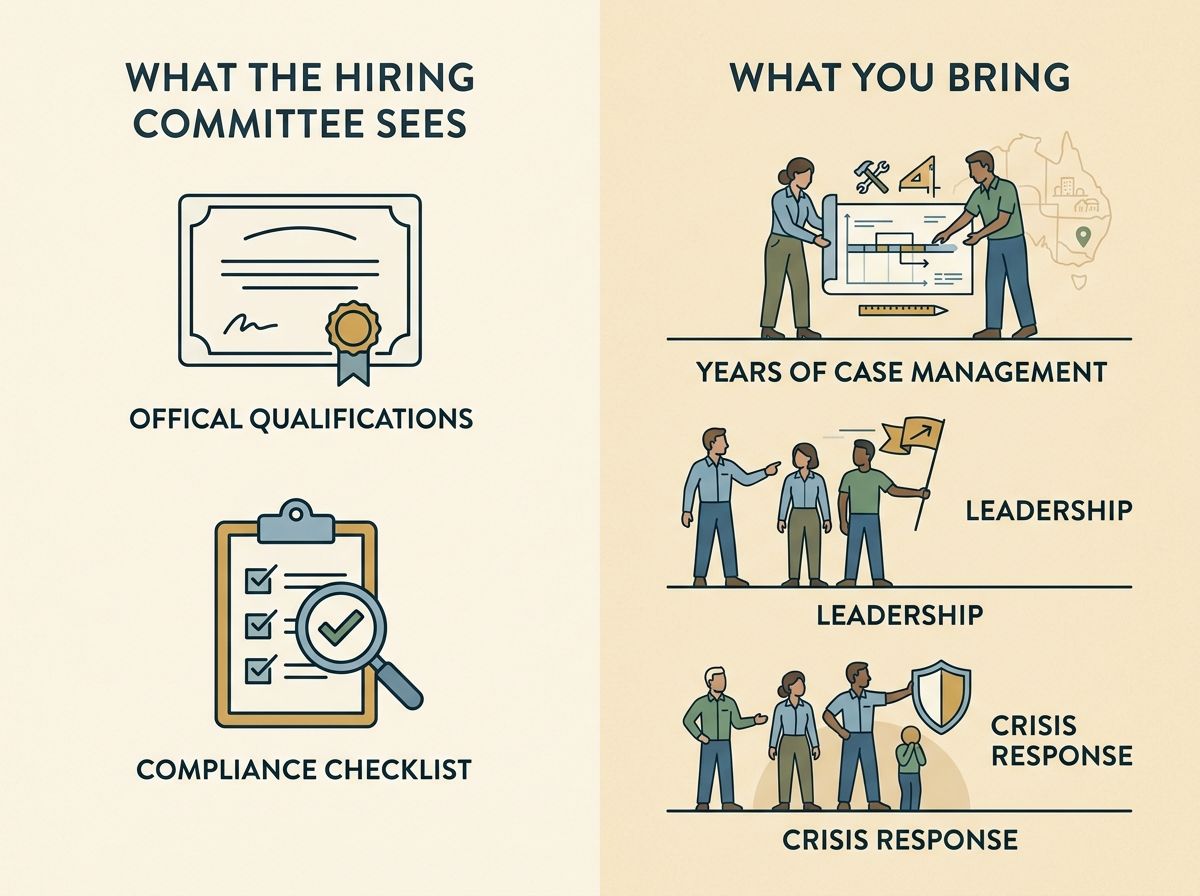
When a hiring committee requires a diploma for a management or coordination role, they are not primarily verifying that the candidate is competent. They are creating an auditable record that protects the organisation.
In regulated and funded sectors, organisations are accountable to funding bodies, regulators, and insurers. If something goes wrong, such as a complaint, an incident, or a review, the organisation needs to demonstrate that it made defensible decisions. A formally qualified manager is a defensible decision. An experienced worker without a formal qualification, regardless of their actual capability, creates a gap in that audit trail.
They are not assessing your competence. They are managing their risk. Those are two very different things.
This is not a conspiracy. It is a structural reality of how regulated sectors operate. Funding agreements often specify minimum qualification requirements for key personnel. Insurers may require evidence of formal credentials for management roles. Regulatory frameworks in aged care, disability, and child and family services increasingly mandate formal qualifications for people in positions of responsibility. The hiring committee is not choosing the better candidate. They are choosing the candidate who makes the organisation defensible.
This is the mechanism behind what many experienced workers describe as
Why a graduate with a diploma wins, even when you are better
A recent graduate with a Diploma of Community Services holds a credential the organisation can point to. Their competence may be untested. Their experience may be thin. They may not know the difference between a safety plan and a risk assessment in practice. But their qualification is in a form the system recognises and can defend.
You, with your decade of frontline experience, your complex case management, your crisis response, and your supervision of junior staff, bring something the graduate cannot replicate for years. But your competence exists in a form the hiring committee cannot easily audit.
Their qualification is auditable. Yours is not. That is the only difference that matters to the committee.
This is not a reflection of your capability. It is a structural gap between how competence is acquired through experience and how it is formally recognised through paper. The system is not broken. It is working exactly as it was designed. The problem is that it was not designed with you in mind.
This dynamic plays out across the sector in ways that are rarely named directly. Our piece on
explores how this pattern affects workers at every level of the sector.
The strategic move: changing what you signal
The solution is not to become more competent. You already are.
The solution is to change the form your competence takes.
RPL for the Diploma of Community Services is not a training program. It is a recognition process. It converts the experience you already have into the credential the hiring committee needs to see. When you hold the diploma, you are the same worker, but your competence is now in a form the system can audit and defend.
Recognition of Prior Learning exists precisely for this situation. It is the mechanism that allows a registered training organisation to assess your existing skills and knowledge against the requirements of a formal qualification, without requiring you to sit through content you already know. Your years of case management, your supervision experience, your program coordination, and your crisis response are not irrelevant to the qualification. They are the qualification. The RPL process is how you demonstrate that.
addresses this directly.
What RPL for the Diploma of Community Services actually involves
RPL involves genuine assessment. It is not a shortcut, and it is not a rubber stamp. A registered training organisation conducts the assessment, and RPL it guides you through the process of preparing your evidence and presenting your experience in the format the assessor needs to see.

This typically involves documenting your work history and the roles you have held. You gather evidence of the work you do, such as records of cases managed, examples of the decisions you make, position descriptions that reflect your actual responsibilities, and references from supervisors or colleagues who can speak to your practice. You may also be asked to respond to scenario-based questions or demonstrate your knowledge in specific areas.
The process requires effort. Making invisible competence visible is not passive. But it is a very different kind of effort from sitting in a classroom learning things you already know.
It is also worth noting that if the assessment identifies areas where your experience does not yet meet the qualification requirements, gap training may be required. This is part of the process, not a failure. The goal is genuine recognition, and that means genuine assessment.
Qualifications are issued by registered training organisations, not by RPL it. Our role is to guide you through the evidence-gathering and preparation process so that your experience is presented clearly and completely for assessment.
The next step: find out if your experience qualifies
You now understand the mechanism. You understand why the system works the way it does. You understand that the diploma is not a competence test, but a liability shield. And you understand that RPL is the process that puts you on the same side of that equation as the graduate who just got the job you deserved.
The question is whether your specific experience maps to the Diploma of Community Services. That is what the Free Skills Review is for.
offers a useful frame, even if your background is local rather than international.
The decision is yours. If you want to know whether your experience qualifies, the Free Skills Review is the starting point. It is free, there is no obligation, and it is an honest assessment, not a sales call.
Ready to Get Recognised?
Start with a free skills review to find out if RPL is right for you.