When Real-World Experience Isn't Enough: The Prerequisite Blocking Your Next Study Step
You've mastered your field. But the institution says you need a certificate first. Here's why that happens — and how an RPL certificate changes the equation.

You know the work. The system doesn't recognize it.
You have years of experience under your belt. A decade of it, perhaps even more. You have solved the practical problems they teach in textbooks, and you have trained the university graduates who currently hold the qualifications you do not. Yet, when you apply for the Diploma (the specific program that aligns with where your career needs to go next) the institution sends back a standard form. That form tells you that you must complete a Certificate III before you can even begin.
That response carries a distinct and deflating quality. It is not outright anger, and it is not quite disbelief. Instead, it is the specific, frustrating experience of being told that your decades of hands-on expertise do not count as acceptable evidence of your skills. The system is telling you that the years you spent actually performing the work do not qualify you to study it in a classroom.
This situation is not a personal failure on your part. It is a structural mismatch between how professionals build their expertise in the workplace and how academic institutions are designed to recognize it. You do not lack the necessary knowledge required for your career; you simply lack the formal piece of paper that proves you already have it.
The prerequisite wall: what it is and why it exists
Prerequisite requirements exist within the Australian vocational education and training system because training institutions require a standardised, auditable way to verify that an applicant has foundational competency before they progress to a higher level. A Diploma curriculum assumes you already understand basic industry building blocks, and a Graduate Certificate assumes prior learning. The prerequisite is simply the institution's method of checking that those essential building blocks are in place before you enroll.
The training system is not broken, but it was designed for a linear learner, someone who moves directly from school into sequential courses, collecting certificates as they go. It was never set up for the experienced professional who developed those identical competencies on the job over many years, through practical workplace experience that does not produce a academic transcript.
Your real-world competence remains invisible to an admissions form that only asks for a specific qualification code. Your years of workplace experience do not fit into that neat box. This is a design limitation of the training system, not a reflection of your professional capability or your actual skills.
If you have run into this wall, you are not alone. The process has a name.
The frustration of being forced to learn what you already know
In practice, the prerequisite wall demands that you enrol in a lower-level Certificate III or IV. It forces you to attend classes or click through online modules covering skills you have successfully applied at work for years. You must submit basic assessments to prove knowledge you use daily, spending months of your time and your own money on a qualification that covers ground you passed long ago.

You have done the work, managed the teams, and trained the incoming graduates. Yet the education system asks you to sit in a classroom while an instructor explains those same basic problems to you from the front of the room. It is a waste of your time.
The cost to your professional standing is real, as are the financial commitments and the loss of your personal time. Every month you spend completing a prerequisite course you do not actually need is a month you cannot spend working toward the higher qualification you actually want for your career.
This frustration is common among experienced professionals in business, healthcare, education, IT, community services, and the trades. If your career path was built in the workplace rather than a lecture theatre, the system was not designed with you in mind. However, that does not make your professional experience any less valuable to your industry.
Studying content you have already mastered is a frustrating use of your valuable time.
How an RPL certificate addresses this prerequisite barrier
Recognition of Prior Learning (RPL) is a formal assessment process. A registered training organisation (RTO) evaluates your existing skills and knowledge against the official standards of a qualification. If the assessment confirms that your experience covers the required competencies, the RTO issues the qualification. That formal document is your RPL certificate.
This is not a shortcut; it is simply an alternative route to the same destination. It starts with what you already know instead of assuming you know nothing. The assessment is rigorous. An assessor from the RTO examines your evidence directly against the units of competency in the qualification. The standards are identical, and the resulting qualification carries the exact same national recognition as one earned through classroom study.
Because this qualification is nationally recognised, it carries the same weight as a prerequisite. The institution that told you to complete the Certificate III first will accept your RPL-issued Certificate III in exactly the same way. The door that was closed is now open, not because they changed the rules, but because you now hold the exact document those rules require.
We want to be clear about how this process works in practice. RPL it does not conduct assessments or issue qualifications. Registered training organisations do. What RPL it does is guide you through the process by helping you identify what evidence is needed, how to organize your experience, and what to expect. The assessment is the RTO's professional decision; the guidance is ours.
Understanding how an RPL certificate clears your path is the first step.
Translating years of work into formal recognition is exactly what this process achieves.
How to tell if your experience qualifies for RPL
RPL is not the right fit for everyone, and we believe in being upfront about that. The process is designed for professionals whose practical experience directly covers the required competencies, not for those who are hoping a general work history will be enough to pass the assessment.
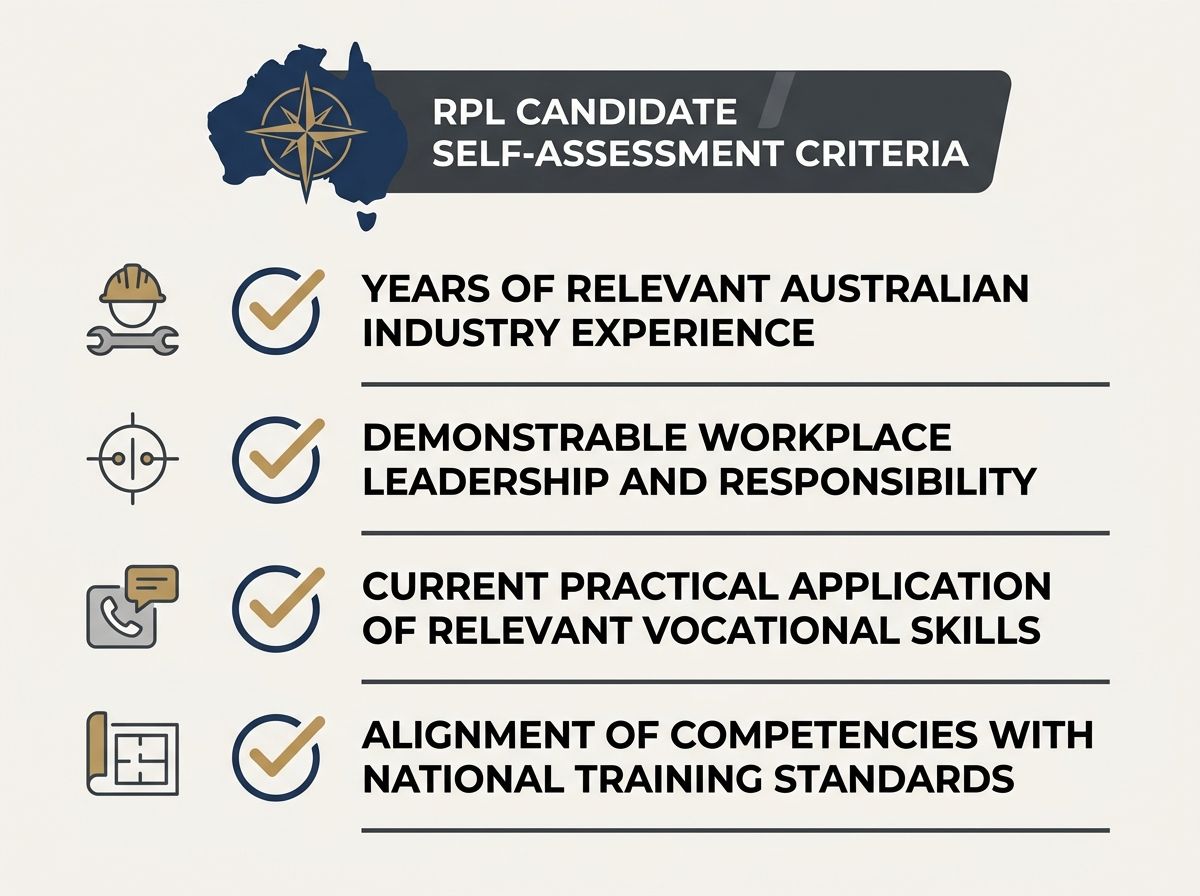
Strong candidates usually share several key characteristics. They have substantial, hands-on experience in their field, typically in roles that required them to apply the competencies covered by the qualification. They can describe specific scenarios where they demonstrated these skills. Finally, they can provide concrete evidence, such as work samples, employer references, project documentation, or third-party reports from supervisors who have observed their work.
- Several years of direct, hands-on experience in your specific industry.
- An employment history that matches the units of competency in the qualification.
- The ability to explain specific workplace scenarios where you applied those skills.
- Access to solid evidence such as work samples, project documents, and professional references.
- A willingness to participate in a structured portfolio assessment process.
You may sometimes need to complete gap training. If an assessor finds that your experience covers most, but not all, of the required competencies, gap training addresses the remaining units. This is not a setback in the RPL process; it is simply the process working honestly. Reputable providers build this training in at no extra cost to the candidate.
If you do not know if your experience qualifies, the practical step is to check before you commit. That is exactly what a Free Skills Review is for.
Evaluating your experience first helps you plan your next move with confidence.
The pathway ahead: what happens next
Once your assessment shows you meet the requirements, the RTO issues your qualification. This credential is fully accredited and nationally recognised. It carries the same standing as a certificate earned through traditional study because the assessment standards are exactly the same.
It meets the prerequisite. The Diploma or Graduate Certificate that seemed out of reach is now open to you. The barrier is gone.
Gaining recognition should not mean starting from scratch. Your RPL certificate is not the final goal; it is the key that opens the door.
There is a legitimate way through the qualifications barrier.
The first step is checking if your experience qualifies. The review costs nothing and carries no commitment. It simply gives you an honest assessment of where you stand so you have the information you need to make the right choice for your career.
Ready to Get Recognised?
Start with a free skills review to find out if RPL is right for you.