You don't need to start from scratch: challenging the 'back to basics' education myth
Formal education does not always start at zero. RPL in Australia formally recognises your existing skills. Learn how the assessment pathway works.

The myth that stops experienced professionals before they start
You have spent years—perhaps a decade or more—doing the actual work. You have managed teams, solved complex problems, and trained colleagues who now outrank you. Yet, you might be told that to get the qualification you need, you will have to start from the beginning.
This assumption—that formal education always begins at zero, regardless of what you already know—is one of the most persistent myths in the Australian workforce. It deters capable professionals from pursuing the qualifications they genuinely need. It sends experienced people back to classrooms to study what they already apply every day. And it is incorrect.
The Australian Vocational Education and Training system has a formal, regulated mechanism designed specifically for people in your position. It is called Recognition of Prior Learning, and it exists because the national education system was never meant to ignore your existing skills. The myth persists because most people first encounter training as beginners. You are not a beginner, and that distinction matters.
Where the 'back to basics' assumption comes from—and why it persists
The assumption is easy to understand. Traditional education is built for people entering an industry for the first time. Qualifications are structured in levels—Certificate II, Certificate III, Diploma, Advanced Diploma—and the natural reading of this structure is that you must progress from the bottom up. If you want a Diploma, the common belief is that you first need a Certificate IV, which requires a Certificate III, and so on.
For someone with no prior experience, that sequence is logical. For someone with ten years of relevant experience, it represents a structural mismatch—and the system has always accounted for this. Recognition of Prior Learning is not a recent addition or an informal workaround. It is a formal, regulated component of the Australian VET system, embedded in the Standards for Registered Training Organisations that govern how these providers operate. RTOs are required to maintain RPL policies and to offer RPL as an assessment pathway to prospective students.
The myth persists not because the system lacks an alternative, but because that alternative is rarely advertised. Most people discover RPL only after they have already enrolled in a course they did not need, or after they have abandoned the pursuit of a qualification entirely.
What RPL qualifications in Australia actually are
Recognition of Prior Learning is a formal, nationally regulated assessment process through which your existing knowledge, skills, and experience are evaluated against the competency standards of a qualification. If the assessment demonstrates that you meet those standards, the qualification is issued. The certificate is identical to one earned through traditional classroom study. The assessment pathway is different, but the outcome is the same.
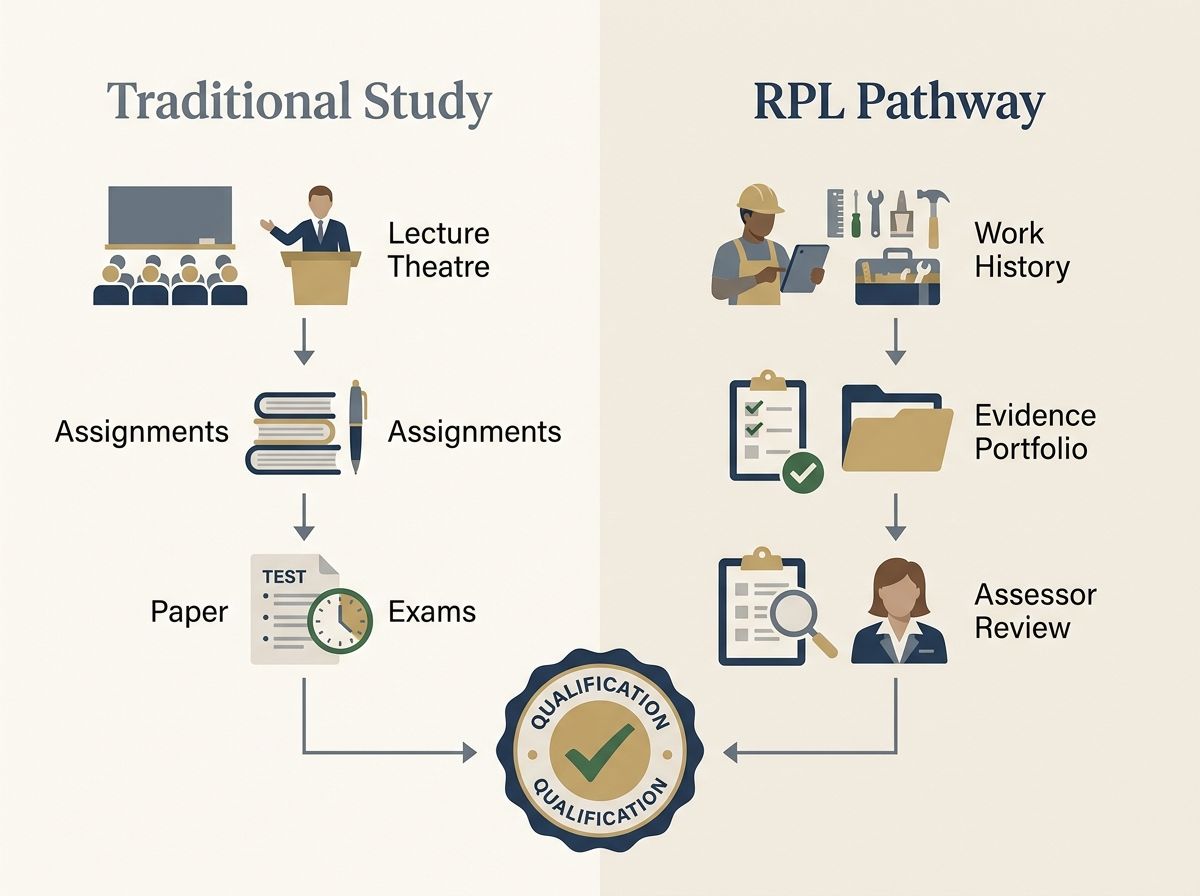
This is the core of the myth-busting argument. RPL is not an exemption or a shortcut. It represents the system functioning as intended for people who have already completed their training on the job.
The Australian Qualifications Framework, which governs all nationally recognised qualifications in Australia, does not distinguish between qualifications issued through traditional study and those issued through RPL. A Certificate IV in Business obtained through RPL carries the same national recognition as a Certificate IV in Business obtained through twelve months of classroom attendance. The competency standards are the same, the issuing RTO operates under the same regulatory framework, and the final certificate does not specify how the qualification was achieved.
Employers and institutions that accept a nationally recognised qualification accept it regardless of how it was earned, provided it was issued by a registered training organisation conducting a genuine competency assessment. That is the essence of RPL.
The formal recognition gap that holds experienced workers back is not about capability, but about documentation.
What the 'start from scratch' assumption actually costs
When the myth goes unchallenged, experienced professionals face a choice between two poor options. They either abandon their goal entirely—deciding that the time and cost of starting over is not worth it—or they enrol in a qualification program and spend months studying content they already know and apply daily.
Certificate III and Certificate IV programs delivered through traditional study typically take twelve to twenty-four months to complete, depending on the qualification and the study load. The cost varies, but can run to several thousand dollars in course fees alone, before accounting for time away from work, the opportunity cost of delayed promotion, and the frustration of sitting in a classroom covering material you have been teaching others for years.
That is the cost of the myth. It means not just frustration, but measurable time, financial expense, and a career that stalls while the paperwork catches up. For a significant portion of the Australian workforce, the gap between what they know and what they can formally demonstrate is not a skills gap. It is a documentation gap, and RPL exists to close it.
The frustration of studying what you already know is not a personal failing, but a systemic problem with a formal solution.
Experience as evidence: how the RPL assessment process works
RPL involves a genuine assessment against real competency standards. It is not a rubber stamp or a mere formality. The assessment is conducted by a qualified assessor from a registered training organisation, and the outcome depends entirely on whether the evidence demonstrates that the competency standards have been met.
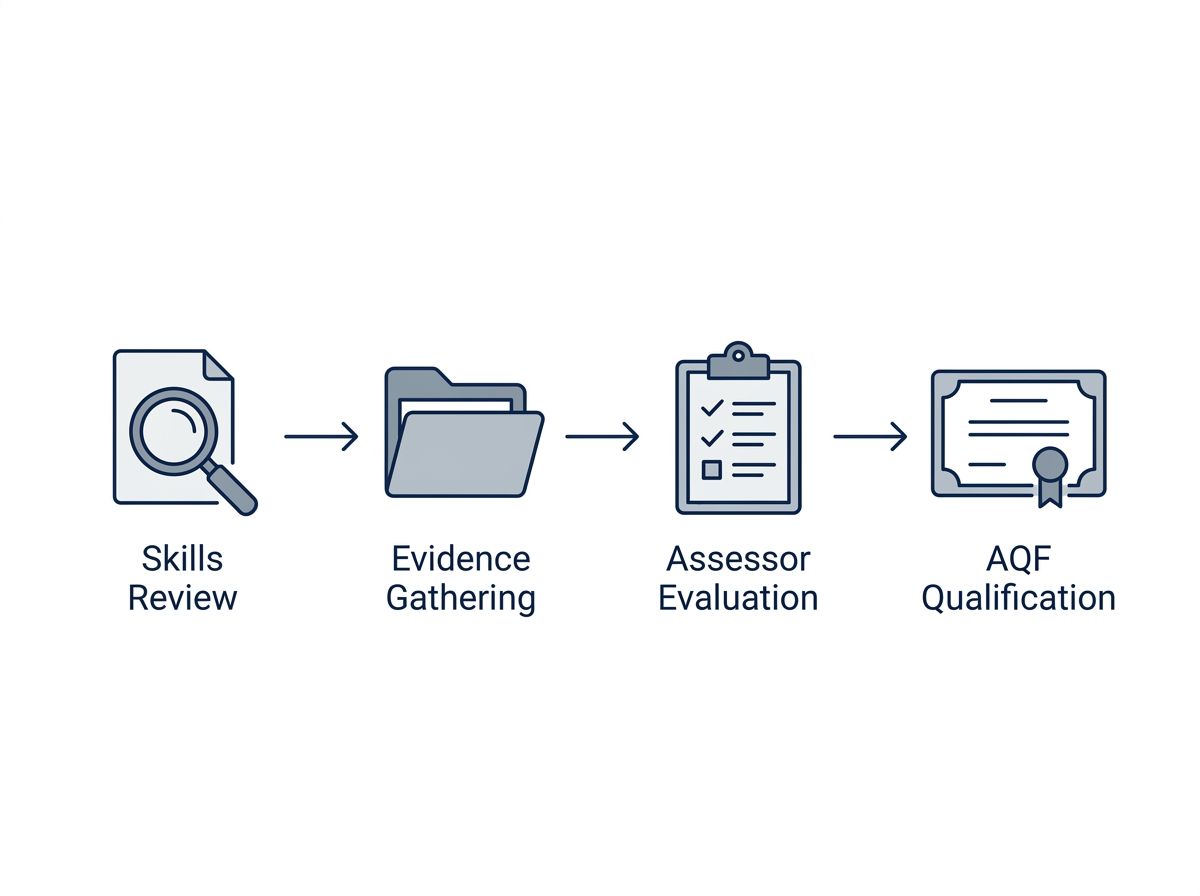
What changes in an RPL assessment is the nature of the evidence. Rather than submitting assignments and sitting exams, you present evidence of your existing competence. That evidence typically includes work samples—such as documents, reports, or records you have produced in your role—along with employer or supervisor statements, professional references, logbooks of work completed, and in some cases, third-party observation or a structured interview with the assessor. The specific evidence requirements vary by qualification and RTO, but the principle is consistent: your existing work becomes the evidence.
It is also worth being direct about one aspect of the process that is sometimes glossed over. If the assessment identifies gaps where your experience does not fully cover the competency standards, those gaps are addressed through targeted gap training. This is a normal part of the RPL pathway, not a failure. Gap training focuses on the specific areas where evidence is insufficient, not a repeat of the entire qualification. The process is rigorous because the qualification is real, and that rigour is what makes the outcome valuable.
Understanding how experience becomes evidence in a formal RPL assessment is the first step in knowing whether the pathway is right for you.
Who the RPL pathway is—and is not—for
RPL is appropriate for people with substantial, relevant, and recent experience in the field covered by the qualification. It is not appropriate for people who are new to the field, or whose experience does not map meaningfully to the competency standards being assessed.
That distinction matters, and being honest about it is more useful to you than a sales pitch. If your experience genuinely covers the competencies in the qualification, RPL is a legitimate and efficient pathway to formal recognition. If it does not, traditional study may be the right option. The starting point is an honest assessment of how well your experience matches the qualification's requirements.
The questions worth asking are straightforward. How many years of relevant experience do you have? Does your current or recent role involve the tasks and responsibilities covered by the qualification? Can you produce evidence—such as work samples, records, or references—that demonstrates those competencies? If the answers are yes, RPL is likely worth exploring. If the answers are uncertain, a suitability review will tell you more than guessing.
The reframe: RPL is the system working correctly
The 'back to basics' myth does not describe how the Australian education system works. It describes how the system works for beginners. You are not a beginner.
Recognition of Prior Learning was built into the Australian VET system because the system's architects understood something important: learning happens in workplaces, not just classrooms. The Australian Qualifications Framework explicitly recognises that qualifications can be achieved through formal study, informal learning, and work experience—and that the pathway to a qualification does not determine its value.
RPL is not the system bending its rules for experienced workers. It is the system applying its rules correctly. The qualification standards exist to ensure that people who hold a qualification can demonstrate the required competencies. RPL tests exactly that, and when the evidence is there, the qualification follows. This is recognition, not repetition.
Understanding why experience alone is not enough without formal recognition is the other side of this argument.
Find out whether your experience qualifies
You have the experience. The question is whether it maps to the qualification you need, and the only way to answer that honestly is to have someone who knows the competency standards look at what you have done.
That is what the Free Skills Review is for. It is not a sales call. It is an honest assessment of whether your experience is likely to support an RPL pathway—before you commit to anything. If it does, you will know what the next steps look like. If it does not, you will know that too, and you can make an informed decision about your options.
RPL qualifications in Australia are available across a wide range of industries and qualification levels.
The decision is yours. The pathway is real, and your experience already exists.
Ready to Get Recognised?
Start with a free skills review to find out if RPL is right for you.