When the roster drops and you legally cannot work: Navigating aged care compliance changes
Aged care compliance rules are changing. If your roster is cut, RPL can turn your experience into a formal qualification without you having to stop working.

The roster drop: When compliance becomes personal
You have been doing this work for years. You know your residents. You know the routines, the medications, the families, and the moments that matter. Then one day the roster changes, or a message comes through from management, and suddenly there are duties you are no longer permitted to perform. This is not because your skills have changed or because anything went wrong. It is simply because you do not hold the specific qualification on paper.
This situation is not hypothetical. It is happening across Australian aged care facilities right now as employers respond to changing regulatory expectations. The frustration, the disruption, and the urgency are very real for many experienced staff members.
This guide is for experienced aged care workers who are facing this transition or who can see it approaching. It explains what is driving these compliance changes, why your floor experience remains highly valuable, and how RPL in aged care can provide a pathway to the qualification your employer requires without you having to leave your job to study.
What is actually driving this: The compliance shift in aged care
The aged care sector in Australia has undergone substantial regulatory reform. The Royal Commission into Aged Care Quality and Safety, which delivered its final report in 2021, made numerous detailed recommendations about the quality of care and the qualifications of the workforce delivering it. These findings focused attention on staff capability and the need for formal, verifiable standards across the sector.
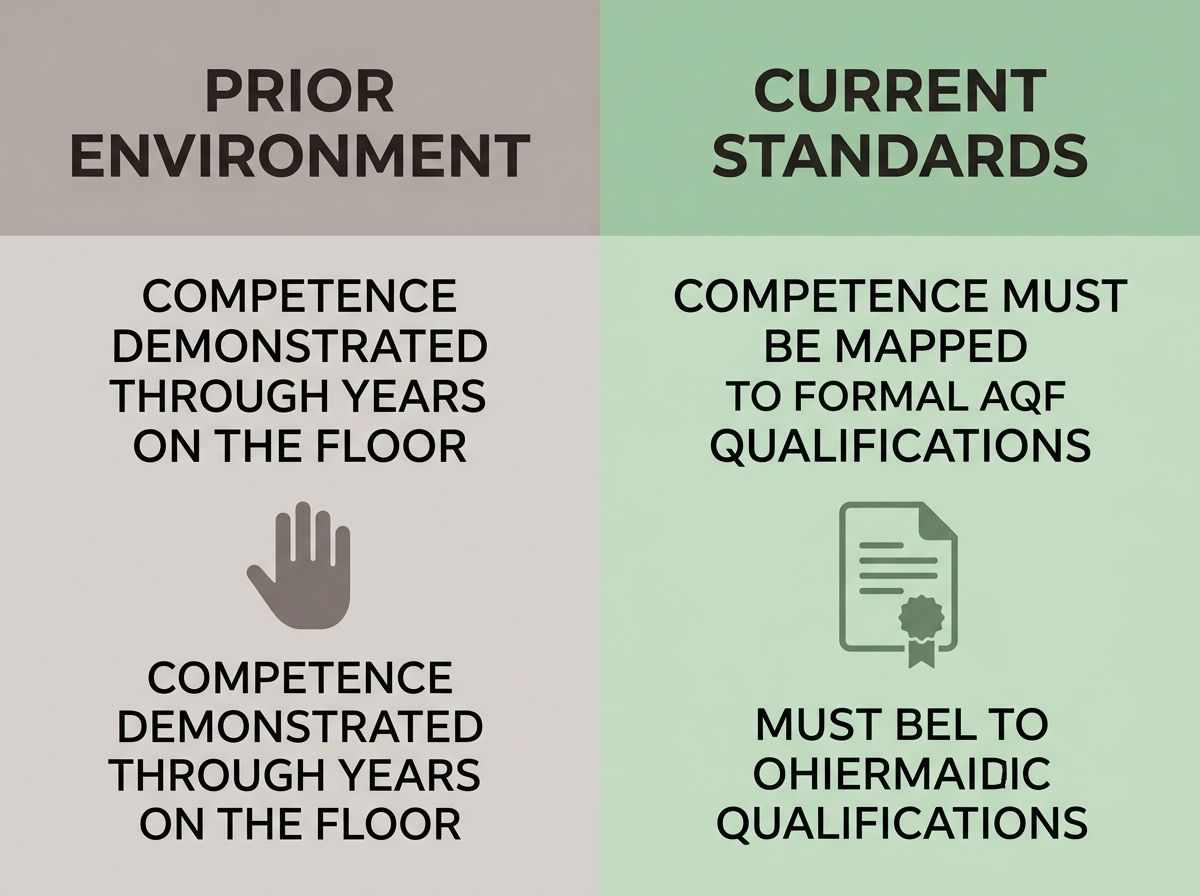
Consequently, there is an ongoing push from regulators, government bodies, and employers to establish a formally qualified workforce. Providers are increasingly requiring staff to hold recognised qualifications, particularly for roles involving direct personal care, to meet their obligations under the Aged Care Quality Standards and their own accreditation requirements.
The specific qualification requirements that apply to your role will depend on your employer, your state or territory, and your work setting. However, the industry-wide trend is clear: formal qualifications are now a baseline expectation rather than an optional extra. If your employer has stated that you need a qualification to continue performing certain duties, they are reacting to these broader industry changes rather than singling you out.
This requirement does not reflect your competence. It is a structural shift in how the sector must demonstrate that competence to regulators and the public. The issue is not your knowledge or your practical skill; the issue is simply the formal format in which your capability is currently documented.
Years of experience do not disappear when the rules change
You have the experience, and these regulatory changes do not erase it.
Every shift you have worked, every resident you have supported, and every difficult conversation you have managed represents real, substantial expertise. This practical knowledge takes years to build and cannot be replicated in a classroom. The updated rules do not reduce its value. They simply mean that the formal system requires this experience to be presented in a specific, documented format before it can grant official recognition.
Experience is not inferior to classroom education; it is simply a different type of evidence. Since you are already doing the job, the issue is not your capability. The focus is finding an assessment pathway that translates your on-the-job expertise into the credential your employer now requires. For the majority of experienced aged care workers, that pathway is available.
What RPL in aged care actually means
Recognition of Prior Learning (RPL) is an established assessment pathway within the Australian Qualifications Framework (AQF). It exists specifically to recognise skills and knowledge acquired through work history, informal training, and hands-on experience rather than classroom study. Rather than a shortcut or workaround, it is a structured, robust assessment process resulting in a standard, nationally recognised qualification based on genuine assessment.
In aged care, RPL commonly applies to qualifications like the Certificate III in Individual Support or the Certificate IV in Ageing Support. If your employer requires a formal qualification, one of these is typically the relevant standard. The precise qualification you need depends on your job description and your employer's specific policies.
An RPL assessment is conducted by a partner Registered Training Organisation (RTO), rather than by RPL it, which assists you through the preparation phase. The RTO assessor determines if your experience meets the required unit competencies of the qualification. This process involves assembling evidence of your daily duties, including workplace records, third-party reports from supervisors or colleagues, and sometimes practical observations or demonstrations. Specific evidence requirements depend on the RTO and the qualification.
The process is thorough, and it is important to be honest about what this involves. RPL is not a matter of submitting a resume and receiving a certificate. It requires demonstrating competency against each unit of the qualification. If the assessor identifies gaps where your experience does not fully meet the standard, you can complete targeted gap training. This gap training is a standard part of the pathway, ensuring your final qualification carries the correct industry weight and integrity.
A successful assessment results in a qualification issued by the RTO. This is a nationally recognised credential meeting the same standard as classroom study. It is fully recognised by employers and regulatory bodies alike, representing the exact same qualification achieved through a practical pathway.
The crisis threshold: When you need to act
While not all aged care workers face immediate roster changes, many do. The following signs indicate that compliance requirements have become an urgent priority for your role:
- Your roster has already been altered to remove duties requiring a formal qualification.
- Your employer has set a firm deadline for you to obtain a qualification or accept a different role.
- Your contract is up for renewal and new qualification requirements have been introduced.
- You have been told that certain shifts or care environments are no longer available to you without a qualification.
- Your employer's accreditation review is approaching and workforce qualification rates are under scrutiny.
If you recognise these signs, the timeframe to transition smoothly is shrinking. Sector compliance standards are not going to reverse. You can choose to address the requirements now on your own terms, or wait until rosters are altered further.
RPL in aged care is designed specifically for this scenario, allowing experienced workers to formalise their skills without pausing their employment. The assessment process is structured to operate around your current roster rather than requiring you to leave your job.
What happens next: The guided pathway from floor experience to formal recognition
Transitioning from work experience to a formal qualification involves several structured steps. This is the process when working with RPL it:
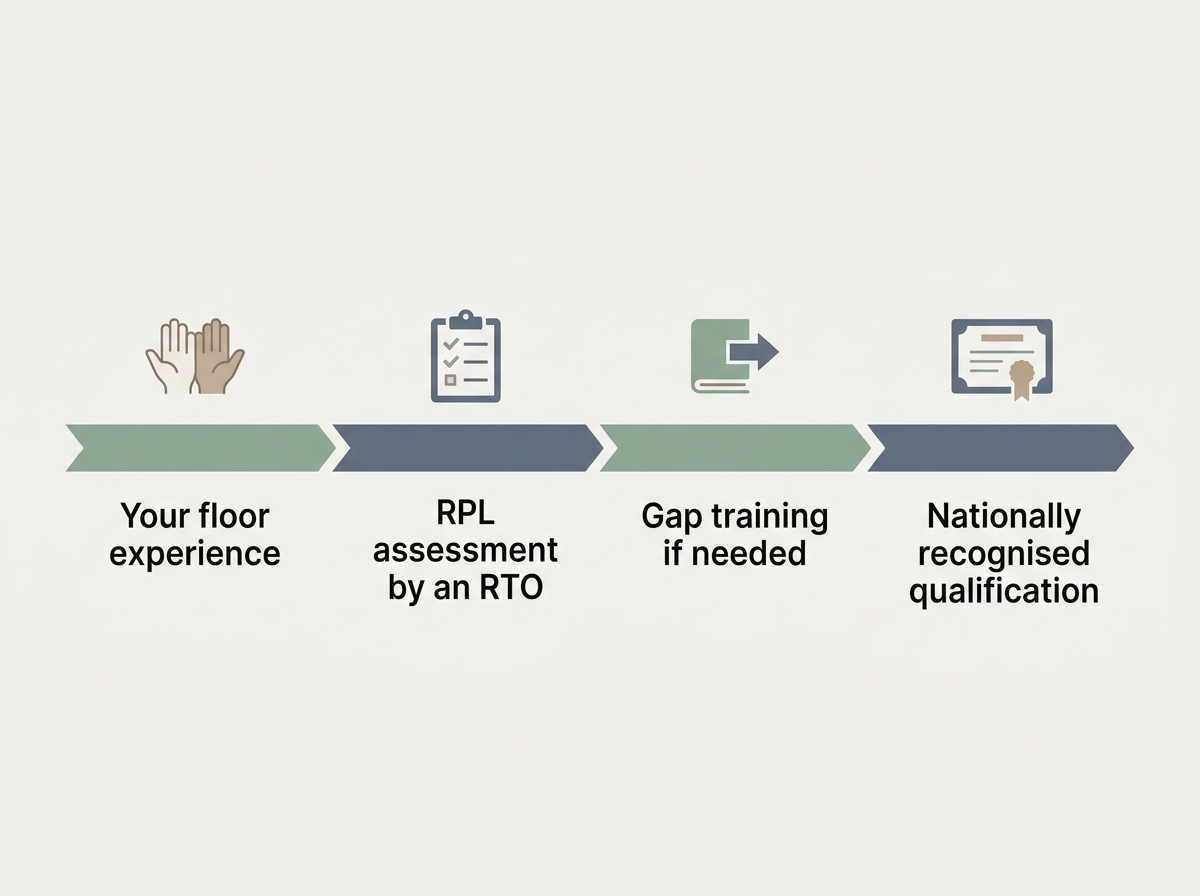
- A Free Skills Review: An initial conversation to evaluate your work experience and determine if RPL is a viable option. This assessment is free, carries no obligation, and focuses purely on your suitability rather than a sales pitch.
- Guided evidence gathering: If you proceed, you receive guidance on identifying and compiling evidence that proves your competence. This occurs around your current shifts, meaning you do not need to stop working.
- RTO assessment: An assessor from the delivering RTO reviews your evidence to verify whether you meet the required competency standards.
- Gap training if required: If the assessor finds any gaps in your evidence, targeted training is provided to complete those specific units.
- Qualification issuance: Upon successful completion of the assessment and any required gap training, the partner RTO issues your nationally recognised qualification.
RPL it assists you with preparation and coordination throughout this process. The formal assessment and qualification issuance remain the responsibility of the RTO. Our role is to help you present your practical experience clearly and systematically to meet the assessment standards.
Your hands-on experience is valuable, and your years of work deserve to be recognized. The decision on how to secure your role is yours.
Frequently asked questions: RPL in aged care
**Is an RPL qualification accepted by aged care employers and regulatory bodies?**
Yes. Qualifications obtained via RPL are issued by Registered Training Organisations (RTOs) registered with the Australian Skills Quality Authority (ASQA). These are nationally recognised under the Australian Qualifications Framework and are identical to credentials earned through classroom study. If you have questions about whether your specific employer or regulator accepts an RPL-derived qualification, you can confirm this directly with them before starting.
**Do I have to stop working to go through the RPL process?**
No. The process is structured to run alongside your current employment. Documenting your evidence, speaking with your guide, and the final assessment are planned to minimise disruption to your shifts. You do not need to take leave or attend scheduled classes.
**What happens if I have gaps where my experience does not meet the standard?**
Gap training is a standard component of the RPL process. If an assessor identifies units where your documented experience does not fully meet the qualification standards, targeted gap training is provided to cover those areas. This is a normal part of the process that maintains the credibility of the qualification, and the necessary training is structured into the pathway.
**How long does RPL assessment in aged care take?**
Timeframes depend on the RTO, the specific qualification, and how quickly you gather and submit your evidence. Because completion times vary based on individual circumstances, we recommend beginning with a Free Skills Review to understand the timeline for your situation. We do not publish generic estimates because they vary widely and depend entirely on your unique circumstances.
**How much does RPL assessment cost?**
Costs depend on the RTO and the qualification required. A Free Skills Review will provide a clear overview of the costs associated with your specific pathway before you make any financial commitments.
**Am I eligible for RPL if I entered aged care without any formal training?**
Your eligibility for RPL depends entirely on your current competency, meaning what you can prove you know and can do, rather than how you originally learned it. Many experienced aged care workers who started in the sector without formal credentials have successfully completed the RPL process. A Free Skills Review is the most practical way to assess your circumstances realistically.
Ready to Get Recognised?
Start with a free skills review to find out if RPL is right for you.