The Hard Work Myth: Why Being Excellent at Your Job Isn't Opening Doors
Working hard isn't enough if formal systems can't see your experience. Discover why RPL Australia exists — and how it turns invisible expertise into recognised qualifications.

The advice that built your career is the same advice keeping you stuck
You have the experience. The work is real. The results are visible — to everyone who has worked alongside you. Your colleagues know what you can do. Your manager knows. The people you have trained know.
But there is a system that cannot see any of it.
The advice most skilled workers receive early in their careers is genuine and well-intentioned: keep your head down, do excellent work, and let your results speak for themselves. For building real competence, this is sound advice. For navigating the formal systems that control promotions, pay rises, and career advancement — it is structurally broken.
The problem is not your work ethic. The problem is that the systems making decisions about your career do not read performance. They read credentials.
What 'hard work speaks for itself' actually requires to be true
The meritocracy assumption behind 'hard work speaks for itself' depends entirely on the evaluator being able to see and interpret the work. In informal settings — your team, your site, your direct manager — this works. They have watched you solve problems. They know your capability firsthand.
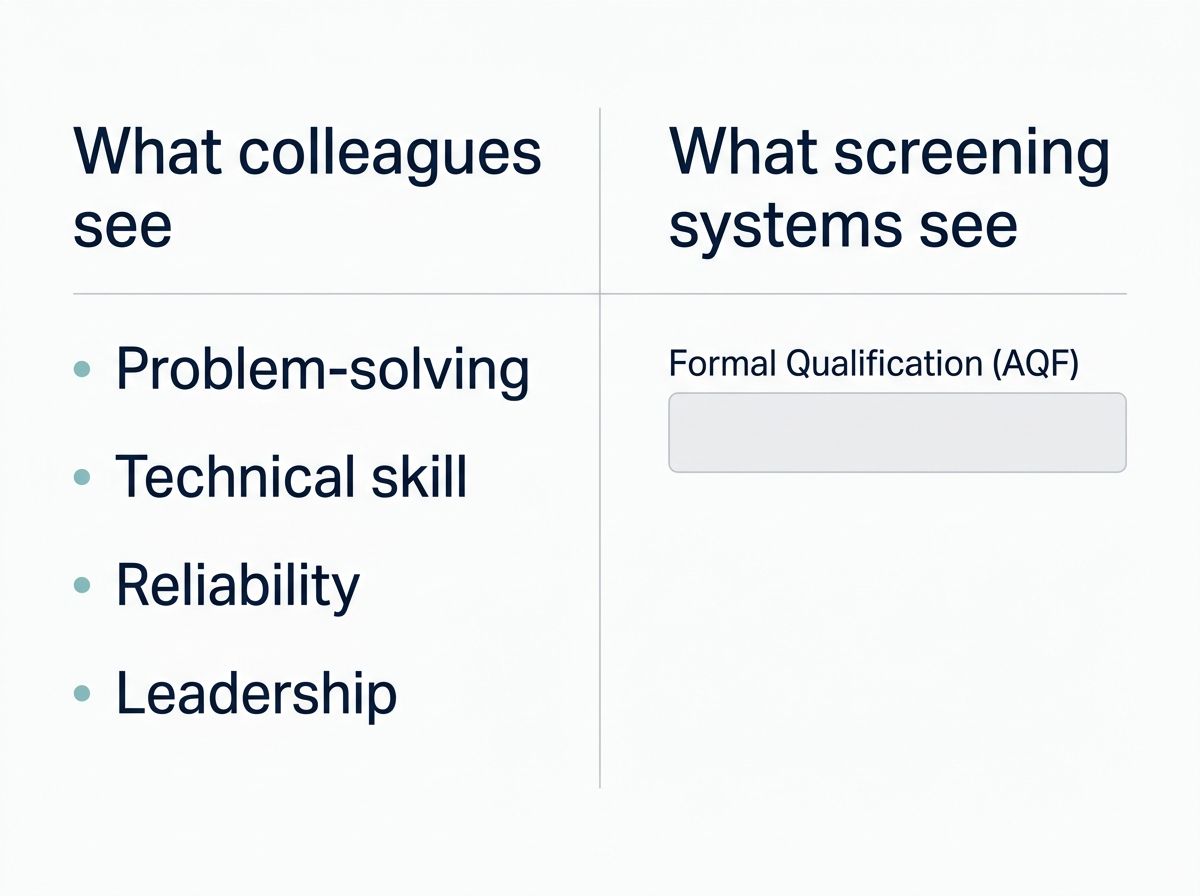
In formal systems, it fails completely.
HR departments screening applications, automated systems filtering candidates, tender committees reviewing submissions, licensing bodies assessing eligibility — none of these read performance. They read credential fields. A qualification box is either ticked or it is not. Experience that exists outside a formal credential is, to these systems, invisible.
In the room where people know you, your work speaks. In the system that decides your next role, it is silent.
This is not a flaw in your approach. It is a structural gap between how competence is acquired — through years of on-the-job learning, mentorship, and real-world problem-solving — and how formal systems are designed to read it.
The credential gap: why Australian workplaces increasingly rely on paper over performance
Across Australian industries, the weight placed on formal qualifications as a gatekeeping mechanism is growing. This is particularly visible in construction, trades, and healthcare — sectors where much of the workforce has historically built skills through experience rather than formal study.
The drivers are real: licensing frameworks, insurance requirements, liability management, and HR standardisation all push organisations toward credential-based filtering. A formal qualification provides a documented, auditable standard. Experience, however deep, does not.
Infrastructure Australia's 2025 Infrastructure Market Capacity Report illustrates the direction of travel clearly. It documents the Australian Government's move toward designing a national electrical licensing scheme — a shift that would make formal qualifications a mandatory national requirement for electricians across state borders. The same report describes the fast-tracking of approximately 2,600 construction skills assessments over two years, and a $78 million Advanced Entry Trades Training Programme specifically designed to help experienced but unqualified workers in residential housing and civil construction gain nationally recognised trade qualifications through recognition of prior learning and gap training.
The Infrastructure Australia 2025 Infrastructure Market Capacity Report documents these policy shifts in detail, including the national electrical licensing reform and the Advanced Entry Trades Training Programme.
The direction is clear: formal credentials are becoming more important, not less. The worker who built their skills on the job is being systematically disadvantaged by systems designed for people who built their skills in classrooms — unless they find a way to translate their experience into the format the system requires.
The invisible expert problem: when your experience exists in the wrong format
Here is the core of it. The problem is not that experienced workers lack competence. The problem is that their competence exists in the wrong format for formal systems to read.
Skills acquired through on-the-job learning are real. The ability to manage a complex project, diagnose a fault, lead a team through a difficult situation, or deliver consistent quality under pressure — these are genuine capabilities. But they are undocumented, unstructured, and invisible to the credential-screening mechanisms that control advancement.
ABS data from the Education and Work, Australia, May 2025 release indicates that 13 per cent of employed Australians aged 15–74 without a non-school qualification work in the highest skill-level occupations — a pattern that points to a significant population of workers whose demonstrated capability exceeds what their formal record shows. This is an indirect indicator, not a precise measure, but it points to a real and widespread pattern.
You have been doing this work for years. You know more than most people with the qualification. But every time you apply for the next level, the first question is about your certificate. That is not a reflection of your capability. It is a reflection of a system that can only read competence in one specific format.
What RPL Australia actually is — and why it exists for exactly this situation
Recognition of Prior Learning — RPL — is the formal mechanism in the Australian VET system designed to assess competence regardless of how it was acquired.
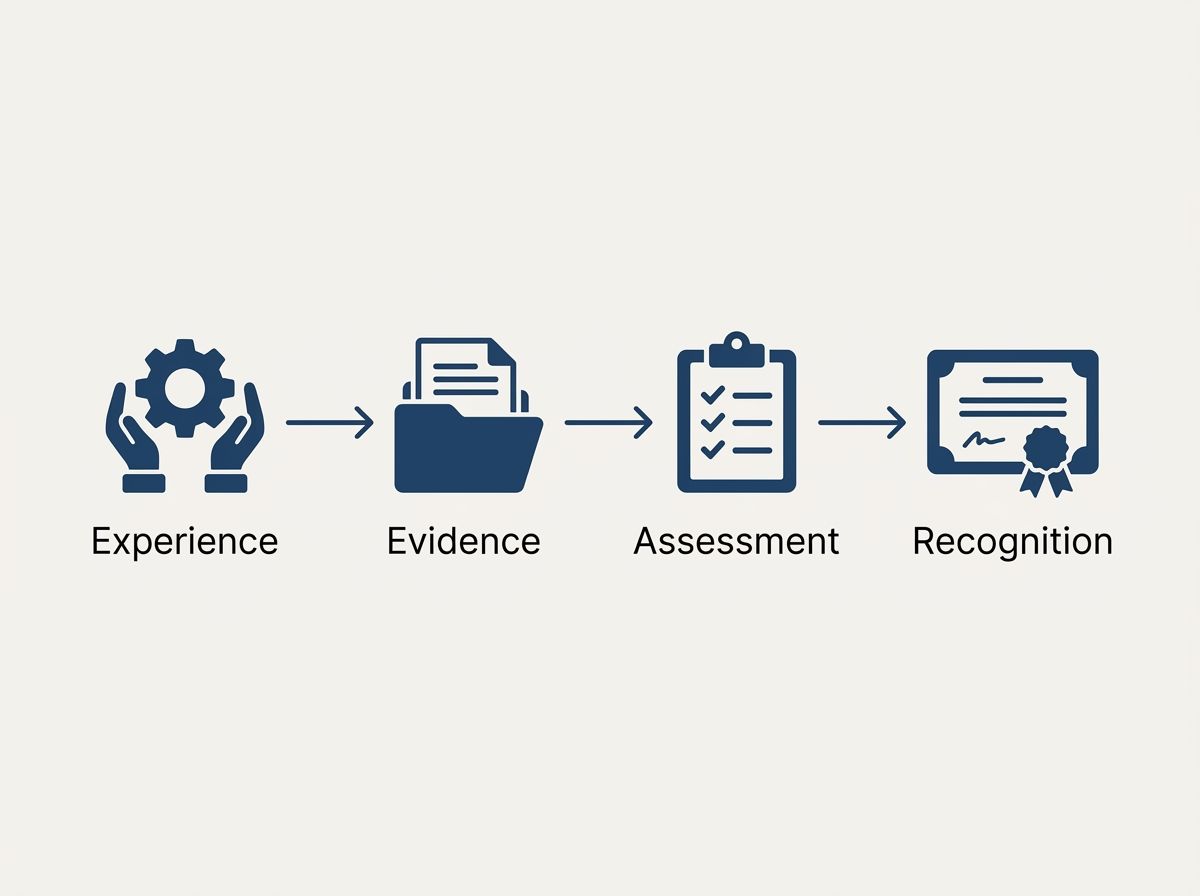
As the Australian Skills Quality Authority (ASQA) defines it, RPL is a legitimate part of the VET sector and the Australian education system. It assesses the competencies of an individual that may have been acquired through formal, non-formal, and informal learning — to determine the extent to which that individual meets the requirements specified in a training package or VET accredited course.
ASQA's guidance on Recognition of Prior Learning confirms that RPL is a formal assessment pathway within the Australian VET system, covering competencies acquired through formal, non-formal, and informal learning.
Formal learning is structured and leads to an AQF qualification. Non-formal learning is structured but does not lead to a qualification. Informal learning results from work, social, family, hobby, or leisure experience. RPL covers all three.
Importantly, under the Standards for Registered Training Organisations, RTOs must offer RPL to individual students — unless the requirements of the training package or licensing requirements prevent this.
RPL exists precisely because the system recognised that on-the-job learning produces real competence that deserves formal recognition. It is not a workaround or a shortcut. It is a rigorous assessment pathway — one designed for people in exactly your situation.
Explore the range of RPL qualifications available across industries in Australia.
The counterintuitive truth: working harder won't fix this — but documenting what you know will
This is the part that most career advice gets wrong.
If the barrier to your next role is a credential gap — a formal qualification that the system requires and you do not hold — working harder will not close it. Delivering better results will not close it. Waiting for your manager to advocate for you will not close it, if the system above them requires a ticked credential box.
The lever is not additional performance. The lever is documentation of the competence you already have.
RPL does not ask you to learn new things. It asks you to demonstrate — through structured evidence — that you already know them. The work you have done for years becomes the basis for formal assessment. Your experience is real. The system just cannot read it yet. RPL is the translation mechanism.
You have done the work. The question is whether you have made it visible in the format the system requires.
What the RPL process looks like in practice
RPL is a genuine assessment process. It is rigorous, and it is conducted by a qualified assessor from a Registered Training Organisation (RTO). RPL it guides candidates through the process — but the assessment itself, and the qualification that results from it, comes from the RTO.
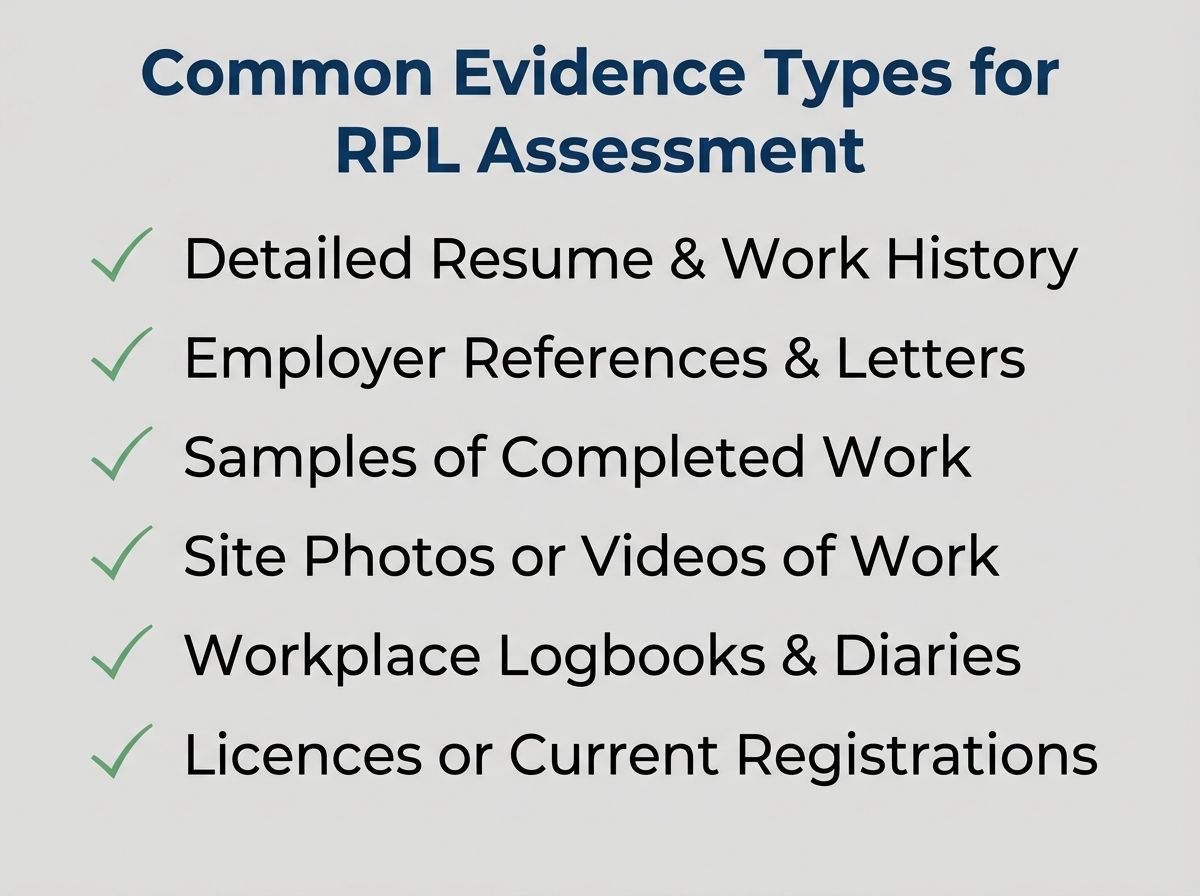
The process typically involves gathering evidence of your existing competence and having it assessed against the specific units of a nationally recognised qualification. Evidence can include a range of materials that demonstrate what you know and can do.
Common evidence types accepted in RPL assessments include resumes and employment history, position descriptions, letters from employers or supervisors, performance reviews, work samples or portfolios, photographs or videos of workplace tasks, professional development records, licences or registrations, third-party reports from supervisors, logbooks or workplace diaries, and interviews or competency conversations with an assessor.
Published guidance from registered training organisations describes the range of evidence typically accepted in RPL assessments, including work samples, employer references, logbooks, and third-party reports.
Timeframes vary. Some RTOs report typical completion ranges of two to eight weeks, depending on the qualification and the evidence available. Others describe processes that can move faster when evidence is well-prepared. These are indicative ranges, not guarantees — timeframes depend on the qualification, the evidence you can provide, and the RTO conducting the assessment.
One important thing to understand: if gaps are identified during assessment — areas where your evidence does not yet demonstrate the required competency — gap training may be required. This is a normal part of the process, not a failure. It means the assessment is genuine.
The WA Government's fact sheet on RPL notes that RPL must be conducted with the same rigour, fairness, and validity as any other assessment — and that it is distinct from Credit Transfer, which is an administrative process. RPL involves genuine assessment of competence.
The Western Australian Government's fact sheet on Recognition of Prior Learning explains the distinction between RPL and Credit Transfer, and the rigour required under current standards.
Is RPL right for your situation? The honest answer
RPL is not right for everyone. That is not a caveat — it is the foundation of honest guidance.
RPL is most likely to be a strong fit if you have substantial, relevant, hands-on experience in the field the qualification covers. If your experience is limited, or in a significantly different area, the assessment may identify gaps that require additional training before recognition is possible.
The right starting point is not enrolment. It is an honest suitability assessment — a conversation about your specific background, the qualification you are interested in, and whether your experience maps to what the assessment requires.
We would rather guide someone to the right pathway than enrol them in the wrong one. That commitment to honesty is what makes the process worth starting.
The decision that changes what the system sees
You cannot change the credential-screening systems. You cannot make HR departments read experience instead of qualification fields. You cannot make licensing bodies accept years on the tools in place of a formal certificate.
But you can change what those systems see about you.
Your skills are real. Your experience counts. Your recognition is earned — it just has not been documented yet.
Recognition should not require starting over. RPL exists because experience can be evidence. The decision to make your experience visible in the format the system requires is yours.
Ready to Get Recognised?
Start with a free skills review to find out if RPL is right for you.