The frustration of stepping down because you don't have a Cert IV Plumbing
You've led crews for years. Now someone with less experience has the Cert IV and you're stepping aside. Here is what that means and what you can do.

You've been leading crews for years. Then this happens.
The foreman pulls you aside. The new contract has come through for a commercial site, a government project, or a major builder. There is a clause: the supervising plumber must hold a Cert IV.
You have been the supervising plumber. You have run the crew, read the plans, managed the apprentices, and solved the problems that come up mid-job when no one else knows what to do. You have done this work for years.
But the younger plumber, the one you trained who still calls you when something goes sideways, has the ticket. So he gets the role.
You step aside.
That moment is a significant setback, not a simple technicality. It means being told, in clear terms, that the licensing system does not recognize what you have built. Your experience is real, and your competence is not in question. But without the formal credential, the system cannot acknowledge what you already know.
If that has happened to you, or if you can see it coming, this article is for you.
Why a piece of paper is outranking years of experience
This is not a matter of your employer doubting your ability. It is a result of how formal construction contracts, site requirements, and licensing work in Australia.
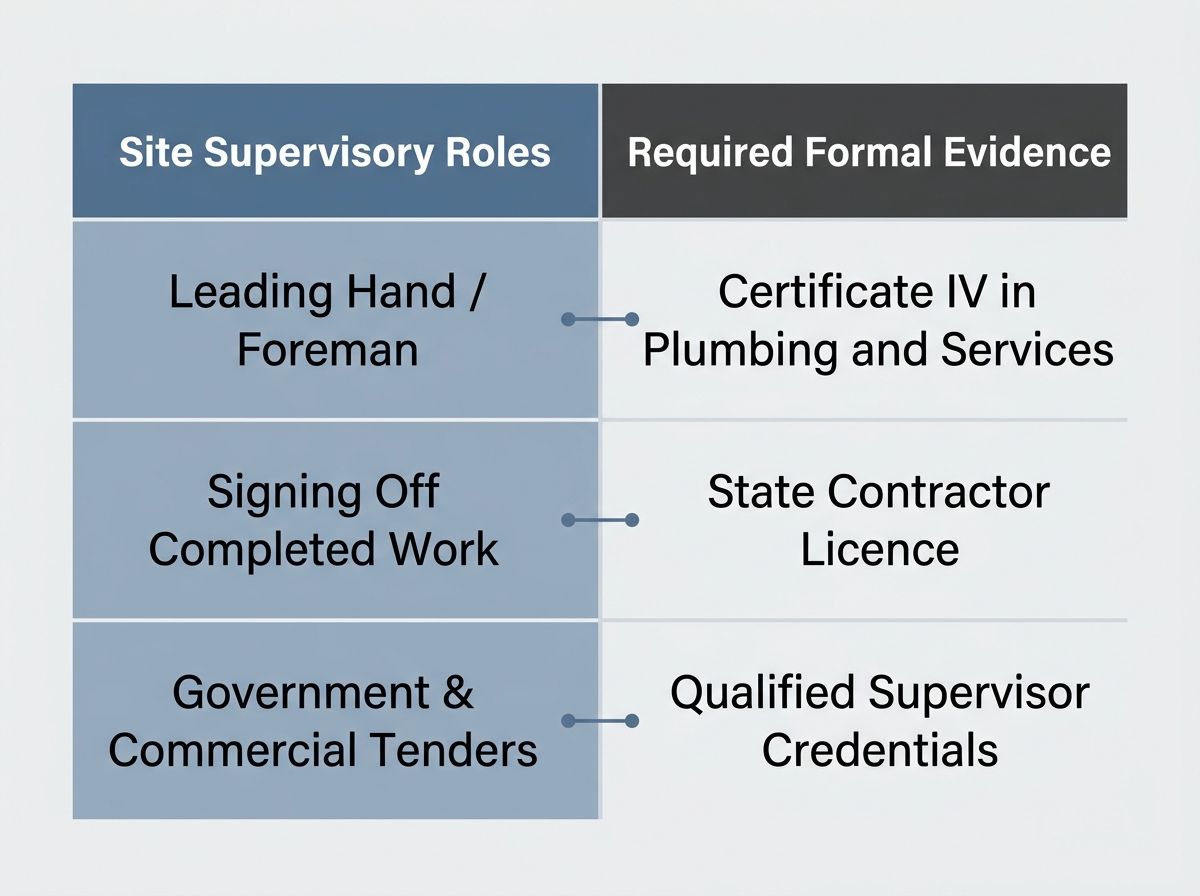
Plumbing licensing is regulated by state authorities across Australia. The specific requirements vary: what NSW Fair Trading requires for a contractor licence differs from what the QBCC requires in Queensland or what the VBA requires in Victoria. In most jurisdictions, however, the pathway to a full contractor licence or a supervisory role requires a qualification at the Certificate IV level. The Certificate IV in Plumbing and Services (CPC40920) is the nationally recognised qualification for this requirement.
Beyond licensing, contract requirements drive this change. Large commercial and government construction contracts increasingly specify qualification levels for key site roles. When a head contractor writes 'Cert IV plumbing supervisor' into a subcontract, the subcontractor has no discretion. They need someone with the ticket on the paperwork, regardless of who is actually the most capable person on site.
Insurance rules add another layer. Some insurers and principal contractors require formal evidence of qualifications for supervisory roles as part of their risk management systems.
None of this is a reflection on your competence. It is simply about the formal evidence of that competence, and the gap between what you know and what the system can currently see.
The specific injustice: less experience, more authority
Here is the part that is hardest to accept.
The person who got the job may be a good plumber, but they do not have your experience. They have not dealt with the problems you have solved, nor have they carried the responsibility you have held quietly for years.
You probably trained them or someone like them. You answered their questions on site, caught their mistakes before they became problems, and made the calls that kept the job moving when the plans were wrong and the timeline was tight.
And now they outrank you on paper.
This inversion is a structural reality, not a perception problem. It marks a gap between what the formal system can measure and what actually happens on site. While the system is not wrong to require formal credentials for supervisory roles, it currently fails to recognize the expertise you already possess.
Your skills are real and your experience counts. The problem is not your knowledge; it is that the formal system has no current record of it.
Your supervisory skills are real. They just need to be recognised.
This is where the situation changes.
The Certificate IV in Plumbing and Services (CPC40920) is not a course designed to teach you how to manage a crew. Instead, it is a qualification that formally recognises supervisory and advanced technical skills. For experienced plumbers, the task is simply demonstrating that you already possess these skills in a format the system can assess and record.
Recognition of Prior Learning (RPL) is the formal assessment process that makes this possible by evaluating your existing skills against national qualification standards. It is a rigorous assessment rather than a shortcut, but it starts from your current knowledge instead of assuming you are starting from scratch.
The competency areas covered by the Cert IV in Plumbing and Services include advanced technical work, planning, compliance, and supervisory functions. These match the responsibilities experienced plumbers carry on site every day. RPL allows a registered training organisation (RTO) to assess whether your existing experience meets those standards, rather than requiring you to re-learn what you already know.
An RPL assessment does not guarantee a qualification. Every assessment is conducted by a qualified assessor from the delivering RTO, and the outcome depends on the evidence you provide. However, for plumbers who have been leading crews and managing complex jobs, the starting point is strong.
What the Cert IV via RPL actually looks like for an experienced plumber
Securing a Cert IV in Plumbing and Services through RPL involves gathering evidence of your existing work, completing an assessment with an RTO, and addressing any identified gaps.
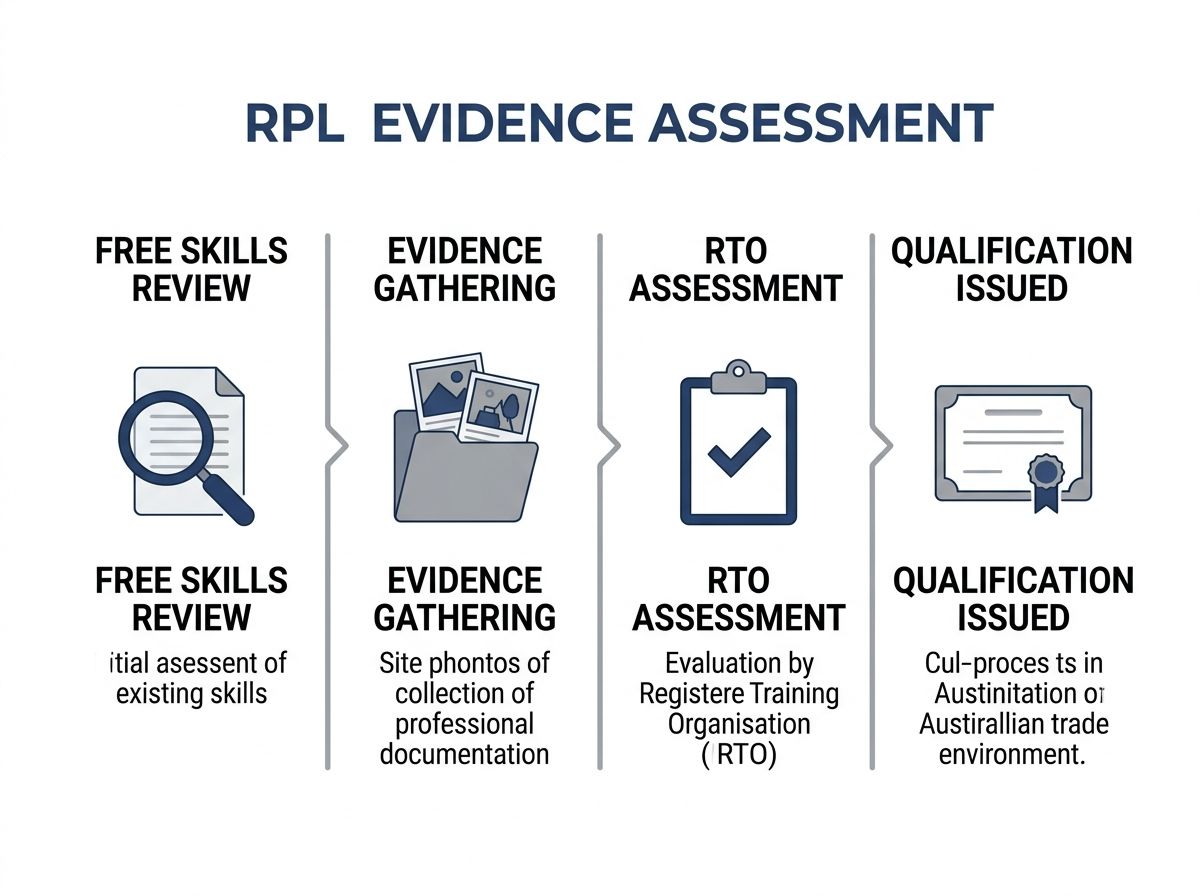
The evidence-gathering process for trade qualifications draws on several practical sources. You may need site photographs documenting the complexity of your work, or a logbook recording your roles and projects. Statements from supervisors, employers, or clients can verify your competence. In some cases, an assessor might request a practical trade test to observe your skills directly.
The specific evidence requirements for CPC40920 are set by the delivering RTO. While different RTOs may approach this differently, the assessment is always genuine. An assessor evaluates whether your skills meet the national standard rather than simply processing paperwork.
Gap training is a real possibility. If your assessment identifies areas where your experience does not fully meet the qualification standard, gap training addresses those specific units. Reputable RPL partners ensure this gap training is included. This is a normal part of the process that ensures your qualification holds real value.
The RTO conducts the formal assessment. RPL it helps candidates gather their evidence and connects them with partner RTOs. When issued, the qualification comes directly from the RTO. It is a nationally recognised credential with the same standing as one earned through traditional classroom study.
- Site photographs documenting work you have completed
- Work history or logbooks detailing your roles and responsibilities
- Statements from supervisors or employers verifying your skills
- Practical assessments or trade tests if required by the RTO
- Gap training for units not fully evidenced, usually included at no extra cost
The difference between being passed over and taking control
You are likely reading this because someone with less experience has taken a role you should have, or because you can see that moment coming.
Securing a Cert IV through RPL does not change past frustrations, but it dictates what happens next in your career.
In most Australian states, a plumbing contractor licence allows you to run your own business, quote work, and sign contracts. This licence requires a qualification at the Cert IV level. The setback you experienced is more than a missed role on one site; it is a ceiling on your career that remains in place until you get the credential.
The qualification does not create your skills; it simply makes them visible to regulators and contractors. Your experience is the substance, and the Cert IV is the format the licensing system recognizes.
You already have the experience. The only question left is whether you want the formal recognition that proves it.
The choice is yours.
To learn more about the Certificate IV in Plumbing and Services (CPC40920) and the topics it covers, visit the RPL it qualification page.
Ready to Get Recognised?
Start with a free skills review to find out if RPL is right for you.