Why Your Cert III is Suddenly Holding Your Career Hostage
Your Cert III got you this far — but it's now blocking permits, contracts, and independence. Here's what a Cert 4 in plumbing actually unlocks for experienced tradies.

The moment you realised your Cert III wasn't enough
You've been doing this work for years. You know the systems, the codes, the fixes that only come from time on the tools. Then a tender document lands on your desk — or a site manager asks a question — and suddenly the qualification you've held for a decade isn't the right one. Not because your skills have changed. Because the paperwork has.
This is happening to experienced plumbers across Australia right now. The Cert III that qualified you to work, that got you through your apprenticeship and onto the tools, has become a ceiling. Not a floor. A ceiling. The frustration of that realisation is entirely legitimate.
If you've searched 'cert 4 in plumbing' recently, you're probably already at that point. This article explains what changed, what a Cert IV actually unlocks, and why your existing experience may already cover most of what's required to get one.
What changed — and why it happened to you
The shift is structural, not personal. Australian plumbing licensing frameworks have long distinguished between working under supervision and operating independently. A Certificate III in Plumbing qualifies you to perform plumbing work — but in most states, it is a Certificate IV that opens the door to contractor licences, permit-pulling rights, and the ability to supervise other plumbers.
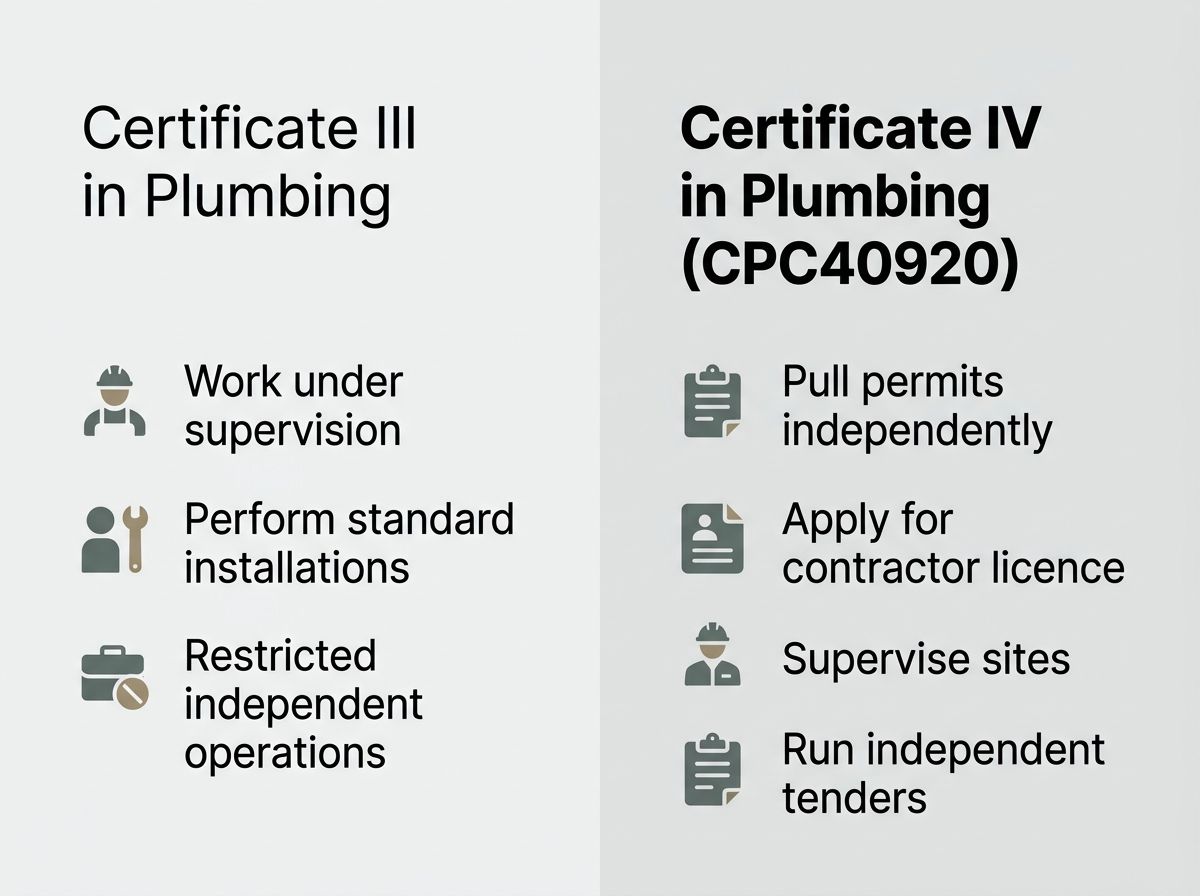
This distinction has always existed in the licensing framework. What has changed is how consistently it is being enforced — and how visible it has become in commercial contexts. Insurance underwriters, principal contractors, and government tender processes are increasingly requiring evidence of the right credential level, not just years of experience. The informal arrangements that once allowed experienced Cert III plumbers to operate with significant autonomy are giving way to formal credential checks.
In Western Australia, for example, recent reforms to plumbing regulation have included proposed requirements for contractors to hold public liability and professional indemnity insurance — changes that flow through to the credential requirements for independent operation. The broader pattern across states is similar: as the regulatory environment tightens, the gap between Cert III and Cert IV becomes more commercially significant.
Licensing, legislative, regulatory and certification requirements vary between states and territories. The specific activities that require a Cert IV — and the licensing body that governs them — differ depending on where you work. What is consistent is the direction of travel: the credential matters more than it used to.
The part that stings: watching less-experienced plumbers get ahead
Here is the part nobody says out loud. You watch a younger plumber — less time on the tools, less site experience, fewer jobs under their belt — walk into a contract you couldn't tender for. Not because they're better. Because they have the right piece of paper.
That is not jealousy. That is a legitimate injustice. The system is rewarding credential format over demonstrated competence. Your skills are real. Your experience is deep. But in formal systems, invisible expertise counts for nothing.
The construction industry is one of the most credential-sensitive sectors in Australia. In a market where construction wages have been rising — the ABS reported a 2.0% increase in construction industry wages in the March 2026 quarter — access to higher-value work is increasingly tied to formal qualification level, not just years of experience.
The commercial reality is straightforward: a Cert IV holder can pull permits, hold a contractor licence, and supervise others. A Cert III holder, in most contexts, cannot do those things independently. The jobs that require those capabilities go to the people who can demonstrate the credential — regardless of who actually has the deeper skill.
That is the thing that stings. And it is fixable.
What a Cert IV in plumbing actually unlocks
The Certificate IV in Plumbing and Services (CPC40920) is the nationally recognised qualification that sits above the Certificate III. According to provider materials derived from the national register, it is designed for experienced plumbing service operators with advanced technical skills and responsibility for project design and supervision — as well as for hydraulic consultants.
In practical terms, holding a Cert IV in plumbing (CPC40920) is typically the qualification threshold for:
- Applying for a plumbing contractor licence in most Australian states and territories
- Pulling permits for plumbing work independently
- Supervising other plumbers and tradespeople on site
- Operating as a hydraulic designer or consultant
- Tendering for contracts that specify contractor-level credentials
- Meeting insurance underwriter requirements for independent plumbing businesses
The qualification comprises 15 units of competency — 10 core units and 5 elective units — and is available in two streams: Hydraulic Services Design and Operations. The core units cover the technical and business foundations of advanced plumbing practice, while electives allow specialisation.
Licensing requirements vary by state and territory, and the specific activities that require a Cert IV will depend on your jurisdiction. We recommend checking with your relevant state licensing authority for the requirements that apply to your situation. What is consistent is that CPC40920 is the qualification that satisfies those requirements across Australia.
You can find full details about the Certificate IV in Plumbing and Services (CPC40920) and the RPL pathway on the qualification page.
Your experience already covers most of it — the problem is the format
Here is the thing about the Cert IV: if you have been working as a plumber for several years, doing complex installations, managing jobs, and solving problems that only come with real site experience, you have almost certainly been working at Cert IV level already. The work you do every day reflects the competencies the qualification assesses.
The problem is not your skill. The problem is that your skill exists in the wrong format for formal recognition. It lives in your hands, your memory, your job history — not in a qualification certificate. And the formal system can only see what has been formally assessed.
Recognition of Prior Learning (RPL) is the mechanism that changes this. RPL is a formal assessment pathway within the Australian VET system that allows a registered training organisation (RTO) to assess your existing skills and knowledge against the units of competency in a qualification. If you can demonstrate that you already meet the standard — through evidence of your work, employer references, site documentation, and practical assessment — the RTO can issue the qualification without requiring you to repeat training you have already done.
RPL is not a shortcut. It is a rigorous assessment pathway. The assessor is looking for genuine evidence of competency, not just years of service. But for an experienced plumber who has been doing the work, the evidence is usually already there — it just needs to be gathered and presented in the right format.
The CPC40920 qualification is designed specifically for experienced plumbing service operators — which means RPL is a natural fit for plumbers who have built their skills on the job rather than through formal study.
How experienced plumbers are getting their Cert IV without starting over
The RPL pathway for CPC40920 follows a structured process. It begins with a suitability assessment — an honest evaluation of whether your experience aligns with the qualification's requirements before you commit to anything. This is the most important step, because RPL is only the right pathway if your experience genuinely covers the competencies being assessed.
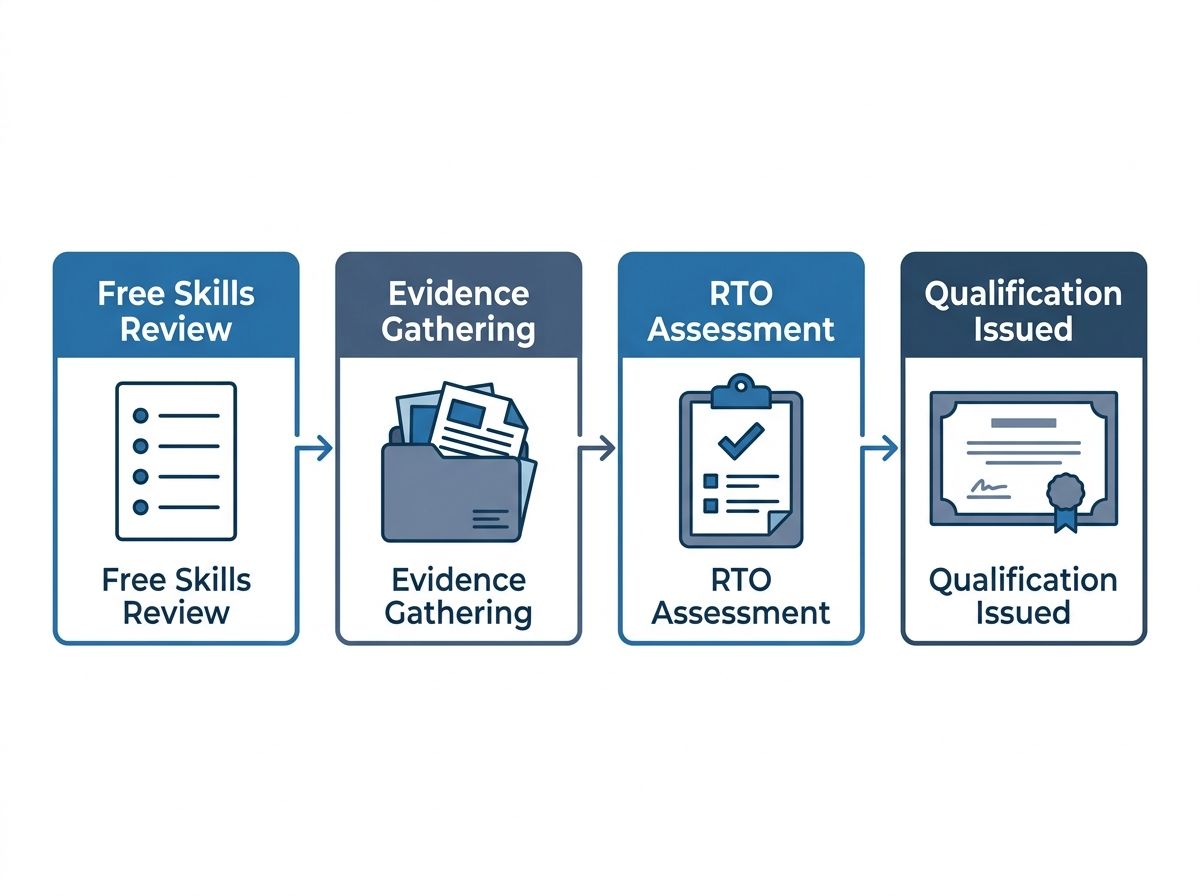
If the suitability assessment confirms you are a good candidate, the next stage is evidence gathering. This typically involves documenting your work history, collecting employer references, gathering site records or photos, and preparing for a practical or knowledge assessment conducted by the RTO's assessor. The specific evidence required will vary depending on the RTO and the stream you are pursuing.
The assessment itself is conducted by a qualified assessor from the delivering RTO. They review your evidence against the units of competency and make a professional judgement about whether you have demonstrated the required standard. If gaps are identified in specific units, gap training is provided — this is normal and does not mean the RPL pathway has failed. It means the process is working as it should.
When the assessment is complete and all units are satisfied, the RTO issues the qualification. The Certificate IV in Plumbing and Services (CPC40920) is nationally recognised because the assessment is genuine — it carries the same standing as a qualification earned through any other pathway.
Indicative timeframes for RPL assessment vary between RTOs and depend on how quickly evidence can be gathered and assessed. Treat this as a guide only: some candidates move through the process in a matter of weeks; others take longer depending on their circumstances. Your RPL provider will give you a realistic picture based on your specific situation.
The first step is finding out where you actually stand
You do not need to commit to anything before you know whether RPL is the right pathway for you. The honest starting point is a Free Skills Review — an assessment of your experience against the requirements of the Cert IV in Plumbing, at no cost and with no obligation to proceed.
The Free Skills Review is not a sales call. It is an honest evaluation. If your experience aligns well with the qualification, you will know. If there are gaps, you will know that too — and you can make an informed decision about whether and how to proceed.
Your skills are real. Your experience counts. The Certificate IV in Plumbing and Services is the formal recognition that makes them visible to the systems that matter — licensing bodies, insurers, principal contractors, and the clients who need to know you can do the job independently.
The decision is yours. Start with the facts.
Ready to Get Recognised?
Start with a free skills review to find out if RPL is right for you.